
Megaphasma denticrus
(Stål, 1875)
Giant Walkingstick
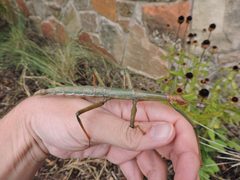
Megaphasma denticrus, the giant walkingstick, is the longest insect native to North America, with females reaching over 150 mm (6+ inches) in body length. This phasmid inhabits wooded areas across the south-central United States and parts of Mexico, where it feeds nocturnally on foliage of trees and shrubs. The species exhibits , with females substantially larger than males, and possesses distinctive rows of teeth on the underside of the middle that aid in identification. Both sexual and have been documented, though the resulting ploidy of parthenogenetic offspring remains poorly understood.
Pronunciation
How to pronounce Megaphasma denticrus: /ˌmɛɡəˈfæzmə dɛnˈtaɪkrəs/
These audio files are automatically generated. While they are not always 100% accurate, they are a good starting point.
Identification
Distinguished from other North American walkingsticks by the combination of enormous size (females over 6 inches), toothed mesofemora visible on the underside of the middle legs, and longer than the front . The northern walkingstick (Diapheromera femorata) is smaller (under 4 inches) and lacks the prominent leg . The two-striped walkingstick (Anisomorpha buprestoides) has distinct longitudinal stripes and defensive chemical glands. Males of M. denticrus can be identified by the single enlarged spine on each hind leg versus multiple smaller spines in females.
Images
Habitat
Wooded areas, particularly oak-dominated forests and glades. Associated with plants including oak, elm, grapevine, mesquite, and various understory vegetation. Found in dolomite glades of the Ozark Highlands and similar rocky, open woodland . Nymphs occur in understory vegetation; frequent taller foliage.
Distribution
North America: primarily south-central United States. Core range in Texas, Oklahoma, and northern Mexico. Peripheral records from Indiana, Alabama, Kentucky, Wisconsin, Iowa, Missouri, Arkansas, Illinois, and New Mexico. Most abundant in wooded regions of Texas and Oklahoma.
Seasonality
active primarily in summer months; nymphs present earlier in season. Large observed in June of some years. Adults have short lifespan of approximately 50 days. stage overwinters; reported from 10 months to possibly 2 years.
Diet
Folivorous: feeds on leaves of oak (Quercus), elm (Ulmus), grape (Vitis), mesquite (Prosopis), and various grasses. Nymphs prefer understory plants; shift to taller vegetation as they develop. feeding habits.
Host Associations
- Quercus - food plantPrimary in Ozark
- Ulmus - food plant
- Vitis - food plantGrapevines
- Prosopis - food plantMesquite
Life Cycle
Hemimetabolous development with , nymph, and stages. Eggs overwinter and hatch following extended incubation (10 months to 2 years). Nymphs undergo multiple , gradually shifting from understory to vegetation. Adults live approximately 50 days. occurs via sexual mating or (); sexually reproducing females produce more eggs, particularly in older individuals. Females exhibit (multiple matings).
Behavior
foliage feeder. Cryptic includes twig-mimicking posture with forelegs extended forward, and slow swaying motion simulating branch movement in breeze. Defensive : can shed legs at predetermined abscission points when grasped by ; leg loss is neurally controlled rather than passive tearing. Rapid sealing of wound prevents excessive fluid loss. cannot regenerate lost limbs.
Ecological Role
Herbivore consuming significant quantities of tree and shrub foliage; occasional localized defoliation reported. Serves as prey for birds and other , though and reduce pressure. Contributes to nutrient cycling through herbivory and as food source for higher .
Human Relevance
Subject of entomological interest due to record-breaking size. Occasionally encountered by hikers and naturalists in wooded . Misidentifications and misspellings of common in literature (e.g., 'dentricus'). Interstate transport regulated by USDA APHIS due to plant-feeding habit. Popular among insect photographers and collectors.
Similar Taxa
- Diapheromera femorataNorthern walkingstick; smaller (<4 inches), lacks toothed mesofemora, more widespread in eastern North America
- Anisomorpha buprestoidesTwo-striped walkingstick; has distinct paired dark stripes, defensive chemical spray, smaller size (~6 inches max), southeastern distribution
Misconceptions
The is frequently misspelled as 'Megaphasma dentricus' in published literature, including some taxonomic papers; this spelling is etymologically nonsensical. cannot regenerate autotomized legs despite some initial confusion— requires at least one . The is not the world's largest walkingstick (that title belongs to Southeast Asian Phobaeticus species exceeding 18 inches).
More Details
Etymology
Megaphasma: Greek 'mega' (large) + 'phasma' (apparition/ghost), referring to giant size and cryptic appearance. Specific epithet denticrus: Latin 'den' (tooth) + 'crus' (leg), referencing the toothed mesofemora.
Reproductive biology
Facultative documented, but ploidy of parthenogenetic offspring unresolved. produces higher in older females. Polygynous mating system in females.
Taxonomic history
Originally described by Carl Stål in 1875 from Louisiana; deposited in Swedish Museum of Natural History. Formerly classified in Orthoptera, now placed in order .
Sources and further reading
- BugGuide
- Wikipedia
- GBIF taxonomy match
- iNaturalist taxon
- NCBI Taxonomy
- Catalogue of Life
- North America’s longest insect | Beetles In The Bush
- Predatory Wasp and Giant Walkingstick Among Top New Species for 2015
- From the Bug of the Week mailbag: World’s largest walking stick visits the Goddard Space Flight Center, Northern walkingstick, Diapheromera fermorata — Bug of the Week