
Diapheromeridae
Kirby, 1904
Common Walking Stick Insects
Genus Guides
5- Diapheromera(northern walkingstick)
- Manomera(blatchley walkingstick)
- Megaphasma(giant walkingstick)
- Pseudosermyle
- Sermyle
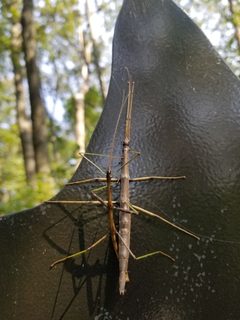
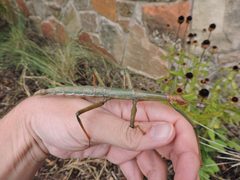
Diapheromeridae is a of stick insects within the order . As of 2025, its exact position within remains unresolved (incertae sedis), not assigned to any known superfamily. The family contains two : Diapheromerinae and Palophinae. Some are notably large, with Paraphanocles keratosqueleton exceeding 30 cm in length. Members of this family are phytophagous and exhibit cryptic stick-like typical of the order.
Pronunciation
How to pronounce Diapheromeridae: /ˌdaɪəfəˈrɒmərəˌdiː/
These audio files are automatically generated. While they are not always 100% accurate, they are a good starting point.
Identification
Diapheromeridae can be distinguished from other by morphological characters including genitalic structures and wing venation patterns. The family contains two : Diapheromerinae (high diversity, 3 tribes) and Palophinae (smallest subfamily, low diversity). Formerly included subfamilies Lonchodinae and Necrosciinae are now placed in the separate family Lonchodidae. -level identification requires examination of genitalic and often geographic information.
Images
Habitat
Diverse including tropical rainforests, mossy forests, cloud forests, and temperate woodlands. occupy and understory vegetation layers.
Distribution
Widespread across Europe, Africa, Asia-Temperate, Indian Subcontinent, Malesia, Philippines, Australia, and the Americas. Specific records include: tropical rainforests of north Queensland, Australia; mossy forests of Northwestern Luzon, Philippines; and various localities in North America including the south-central United States.
Diet
Phytophagous; with broad plant ranges. Specific host associations are documented for some : Sipyloidea stigmata has been reported as a crop pest on black pepper and other economically important plants in India.
Host Associations
- black pepper - pestSipyloidea stigmata reported as first phasmid crop pest in India
- mango - pestvia related (Pharnacia magdiwang/ponderosa) in Philippines
- coconut - pestvia related Graeffea crouanii in Pacific islands
Life Cycle
Hemimetabolous development with , nymph, and stages. Eggs are dropped to the ground from plants. In Sipyloidea sp., egg production occurs continuously across 40+ week periods in tropical environments, declining exponentially from high to low levels rather than showing seasonal wet/dry season patterns. This continuous may relate to polyphagy and year-round resource availability.
Behavior
Cryptic including twig-mimicking posture and swaying movement to simulate wind-blown vegetation. Some exhibit (voluntary leg shedding) as anti- defense, with breakage at predetermined abscission points that seal rapidly to prevent fluid loss.
Ecological Role
Herbivores in forest and woodland ; contribute to nutrient cycling through herbivory and as prey for birds, reptiles, and other arthropods. Some may function as ecosystem engineers through moderate levels of defoliation.
Human Relevance
Generally harmless to humans. Occasionally significant as crop pests: Sipyloidea stigmata is the first documented phasmid crop pest in India, affecting black pepper . Other Diapheromeridae and related phasmids have caused on economically important plants in the USA, Fiji, Australia, China, and the Philippines. Popular in entomological collections and as educational organisms due to their striking .
Similar Taxa
- LonchodidaeFormerly treated as within Diapheromeridae; now recognized as separate containing Lonchodinae and Necrosciinae
- PhasmatidaeAnother large of stick insects; distinguished by morphological characters including wing structure and genitalic
- HeteronemiidaeNew World ; Diapheromeridae has broader geographic distribution
More Details
Taxonomic instability
The classification of Diapheromeridae has undergone significant revision. The Lonchodidae was re-established as a separate , removing the Lonchodinae and Necrosciinae from Diapheromeridae. As of 2025, Diapheromeridae's position within is considered incertae sedis, not assigned to any superfamily.
Subfamily composition
Current are Diapheromerinae (containing 3 tribes, highest diversity) and Palophinae (smallest subfamily, low diversity). The former Lonchodinae and Necrosciinae are now in Lonchodidae.
Research significance
Diapheromeridae includes Megaphasma denticrus, North America's longest insect (exceeding 150 mm, up to 200+ mm with legs extended), which has been featured in entomological photography and research.
Sources and further reading
- BugGuide
- Wikipedia
- GBIF taxonomy match
- iNaturalist taxon
- NCBI Taxonomy
- Catalogue of Life
- Diapheromeridae | Beetles In The Bush
- 2013 ESA World of Insects Calendar Selection | Beetles In The Bush
- Happy Halloween! | Beetles In The Bush
- Philippine mossy forest stick insects: first record of the genus Otraleus Günther, 1935 in the country, with four new species, and the new genus Capuyanus gen. nov. (Phasmida, Diapheromeridae, Necrosciinae)
- A report on Sipyloidea stigmata Redtenbacher (Diapheromeridae: Necrosciinae) as the first phasmid crop pest in India and its redescription
- Egg production across a 40‐week period in the phasmid Sipyloidea sp. (Diapheromeridae) from a tropical rain forest, north Queensland, Australia