
Diapheromera covilleae
Rehn & Hebard, 1909
creosote bush walkingstick
Diapheromera covilleae, the creosote bush walkingstick, is a wingless to the Sonoran Desert region. range from 5–10 cm in length with pronounced : females are larger, grey in coloration, and 3–4 cm longer than males, which are brown. The exhibits strong -plant fidelity to creosote bush (Larrea tridentata) and related desert vegetation. It is strictly and highly cryptic, making detection difficult despite being locally abundant.
Pronunciation
How to pronounce Diapheromera covilleae: //ˌdaɪəfəˈroʊmərə kəˈvɪliˌaɪ//
These audio files are automatically generated. While they are not always 100% accurate, they are a good starting point.
Identification
Distinguished from by combination of: horn-like spines on and ; large tarsal hooks; strict association with creosote bush and desert ; grey female and brown male coloration; absence of wings. length (up to 6 cm) and body proportions differ from Diapheromera femorata, which occupies woodland rather than desert habitats. The toothed mesofemur characteristic of Megaphasma denticrus is absent.
Images
Appearance
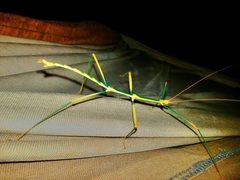
Elongated, cylindrical body resembling a twig. Body length 5–10 cm, with females consistently larger than males. Coloration sexually dimorphic: females grey, males brown. bears small and paired horn-like spines. also bears horn-like spines. Each leg terminates in large tarsal hooks for gripping branches. long, reaching up to 6 cm. Four positioned to . Wings absent in both sexes.
Habitat
Deserts and cactus forests, specifically the Sonoran Desert. Strongly associated with creosote bush (Larrea tridentata) vegetation. Occupies branches of shrubs and trees; occasionally found on ground when moving between perches.
Distribution
Sonoran Desert of southwestern United States (Arizona, New Mexico, Texas) and northwestern Mexico.
Seasonality
Active year-round in suitable conditions; most commonly observed during warmer months. activity pattern restricts detection.
Diet
Herbivorous. Feeds primarily on leaves of creosote bush (Larrea tridentata). Also consumes chunari leaves and various other desert plants. feeding .
Host Associations
- Larrea tridentata - primary plantcreosote bush; primary food source
- chunari - secondary plantunidentified desert plant; secondary food source
Life Cycle
Winter spent in stage. Nymphs and similar in appearance (no wing development through ontogeny). Specific developmental duration and number of instars not documented.
Behavior
Strictly : all movement and feeding occurs at night. Locomotion primarily along branches; occasionally descends to ground to seek new perches or food sources. Employs —motionless posture resembling twigs. Swaying to simulate branch movement in breeze has been observed in related but not explicitly documented for this species.
Ecological Role
Herbivore consuming desert shrub foliage. Prey for birds and lizards. Nutrient cycling through deposition.
Human Relevance
Subject of entomological interest due to and -plant specialization. No documented economic or medical significance. Collection for scientific study requires awareness of habits.
Similar Taxa
- Diapheromera femorataNorthern walkingstick; occupies eastern deciduous woodlands rather than Sonoran Desert; lacks horn-like anal spines; females not distinctly grey, males not distinctly brown; proportionally shorter
- Megaphasma denticrusGiant walkingstick; much larger (females exceed 15 cm); possesses diagnostic rows of teeth on underside of mesofemur; distributed in south-central and eastern US, not Sonoran Desert; longer than front
More Details
Nocturnal habits
The ' strictly activity and exceptional camouflage make it difficult to detect despite local abundance. Most observations result from deliberate night searching or fortuitous encounters with ground-moving individuals.
Mandible structure
Four positioned to allow simultaneous leaf manipulation and visual surveillance of surroundings—an for feeding under risk.
Sources and further reading
- BugGuide
- Wikipedia
- GBIF taxonomy match
- iNaturalist taxon
- Catalogue of Life
- From the Bug of the Week mailbag: World’s largest walking stick visits the Goddard Space Flight Center, Northern walkingstick, Diapheromera fermorata — Bug of the Week
- Happy Halloween! | Beetles In The Bush
- Bug Eric: New Mexico Dragonfly Blitz - Day 1
- North America’s longest insect | Beetles In The Bush
- North America’s longest insect | Beetles In The Bush