
Metrioptera roeselii
(Hagenbach, 1822)
Roesel's Bush-cricket
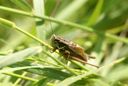
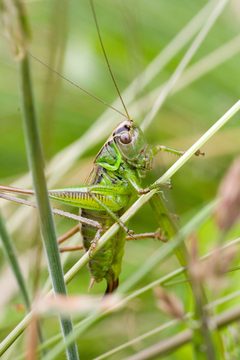
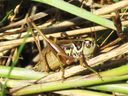
Metrioptera roeselii, commonly known as Roesel's Bush-, is a medium-sized bush-cricket native to continental Europe that has undergone significant range expansion in northern Europe since the 1980s. The is characterized by a distinctive yellow-green coloration with a prominent yellow stripe along the lateral margin of the pronotum. It exhibits wing dimorphism, with both short-winged (brachypterous) and long-winged () forms occurring in ; the long-winged form is associated with range expansion. The species has been introduced to Britain and Scandinavia, with genetic evidence indicating human-mediated in some isolated populations.
Pronunciation
How to pronounce Metrioptera roeselii: //mɛˌtriˈɒptɛra roʊˈzɛli.aɪ//
These audio files are automatically generated. While they are not always 100% accurate, they are a good starting point.
Identification
are distinguished from similar bush-crickets by a bright yellow or cream-colored stripe running along the lateral edge of the pronotum and continuing along the wing bases. The body is predominantly green to yellow-green. The shows wing dimorphism: most individuals are short-winged with wings barely reaching the middle of the , but a fully winged form occurs, particularly at the expanding range margins. The ovipositor is relatively short and curved. The song is a high-pitched, continuous, mechanical-sounding buzz produced by stridulation of the forewings.
Images
Habitat
Rough grassland, hay meadows, pastures, and agricultural landscapes with grassland edges. In the UK, found in suburban parks, neglected grasslands, and roadside verges. Occupies extensively used agricultural landscapes in continental Europe.
Distribution
Native to continental Europe from France and Germany eastward; has expanded its range northward and westward since the 1980s. Now established throughout England, Wales, and southern Scotland, with recent records in northern England up to 300 m elevation. Also recorded in Scandinavia (Sweden, Denmark) and the Baltic region. Isolated in northern Europe show genetic signatures consistent with human-mediated introduction.
Seasonality
active from July through October in northern Europe. Nymphs develop through spring and early summer.
Life Cycle
are laid in soil or vegetation using the female's sword-like ovipositor. Nymphs hatch in spring and resemble miniature without wings; they develop through successive to reach adulthood by mid-summer. Wing buds become visible in later instars. The exhibits hemimetabolous development with no pupal stage.
Behavior
Males produce a continuous, high-pitched calling song to attract females. Mating occurs with the female mounting the male; males transfer a that remains partly visible externally and is often consumed by the female after mating. The long-winged form shows enhanced capability and is associated with of new areas at the range margin. Short-winged individuals are effectively flightless and show limited dispersal.
Ecological Role
As a herbivore in grassland , contributes to nutrient cycling and serves as prey for birds, small mammals, and . The ' range expansion in northern Europe has been used as a biological indicator of climate warming effects on insect distributions.
Human Relevance
Subject of ecological research on range expansion, climate change impacts, and invasion . Popular with citizen scientists; records contribute to the Grasshoppers and Related Insects Recording Scheme for Britain and Ireland. The ' distinctive song and appearance make it readily identifiable by amateur naturalists.
Similar Taxa
- Conocephalus fuscusLong-winged Conehead has a more slender body, longer wings in all individuals, and a different song pattern; lacks the prominent yellow lateral stripe of M. roeselii.
- Leptophyes punctatissimaSpeckled Bush-cricket is smaller, speckled with dark markings, and has a more delicate build; produces a short, intermittent song rather than continuous buzz.
- Tettigonia viridissimaGreat Green Bush- is substantially larger, has a long, straight ovipositor, and lacks the yellow lateral stripe; song is a loud, intermittent chirp.
Sources and further reading
- BugGuide
- GBIF taxonomy match
- Catalogue of Life
- Encyrtid Holdings | Entomology Research Museum
- The Changing Distributions of our Grasshoppers, Crickets and Relatives - Buglife Blog - Buglife
- Don't get bogged down with peat... - Buglife Blog - Buglife
- What’s the difference between a cricket and a grasshopper? - Buglife Blog - Buglife
- Colonization history of Metrioptera roeselii in northern Europe indicates human‐mediated dispersal
- Modelling the distribution of the invasive Roesel’s bush-cricket (Metrioptera roeselii) in a fragmented landscape
- Changes in land use and habitat availability affect the population genetic structure of Metrioptera roeselii (Orthoptera: Tettigoniidae)
- Limited gene flow may enhance adaptation to local optima in isolated populations of the Roesel’s bush cricket (Metrioptera roeselii)