
Metrioptera
Wesmaël, 1838
bush crickets, bog bush crickets, meadow bush crickets
Species Guides
2- Metrioptera roeselii(Roesel's Bush-cricket)
- Metrioptera sphagnorum(bog katydid)
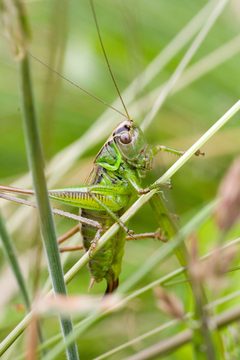
Metrioptera is a of bush crickets (Tettigoniidae) in the tribe Platycleidini, commonly known as bog and meadow bush crickets. The genus contains approximately 10 distributed across Eurasia, including notable species such as Metrioptera brachyptera (the bog bush ), M. roeselii (Roesel's bush cricket), and M. bicolor. Species within this genus have been extensively studied as model organisms for understanding insect , genetics, and . Several species exhibit wing dimorphism, with both fully winged and short-winged or flightless forms occurring within populations.
Pronunciation
How to pronounce Metrioptera: /mɛˈtɾiɔptɛɾa/
These audio files are automatically generated. While they are not always 100% accurate, they are a good starting point.
Identification
Metrioptera are medium-sized bush crickets typically distinguished by their coloration patterns and wing . Metrioptera brachyptera is flightless with reduced forewings, while M. roeselii is fully winged and capable of . M. bicolor shows a distinct two-color pattern. Species identification often requires examination of male genitalia and analysis of the stridulatory file on the forewings. Acoustic analysis of male calling songs provides a reliable species-level diagnostic, as each species produces species-specific songs with distinct syllable rates, frequency spectra, and temporal patterns.
Images
Habitat
vary by . Metrioptera brachyptera is strongly associated with peat bogs and damp meadows, particularly those with Sphagnum moss tussocks. Metrioptera roeselii prefers grassland habitats and has shown adaptability to fragmented agricultural landscapes. Metrioptera sphagnorum is restricted to Sphagnum bogs. Metrioptera bicolor occurs in grassland patches and meadows. The as a whole favors moist, grassy environments with dense vegetation structure.
Distribution
Eurasian distribution ranging from western Europe through to Asia. Metrioptera brachyptera occurs across England, Wales, and southern Scotland, extending through northern Europe. Metrioptera roeselii has a native range along the Baltic Sea coast with introduced in Denmark, the Scandinavian Peninsula, and the British Isles. Metrioptera bicolor is found in Sweden and other parts of northern Europe. Several have expanded their ranges through human-mediated .
Behavior
Males produce -specific calling songs using stridulation of the forewings. The song of Metrioptera brachyptera consists of five syllables per chirp with main sound energy between 15–85 kHz. Metrioptera sphagnorum produces a prolonged trill alternating between two intensity levels, with males prolonging the audio-dominated stridulation mode when approached by males, suggesting intrasexual acoustic competition. ability varies dramatically: M. brachyptera is flightless with limited active dispersal, while M. roeselii is a strong flier. M. bicolor shows intermediate dispersal capabilities with interpatch important for metapopulation dynamics.
Human Relevance
Several Metrioptera serve as important model organisms in ecological and evolutionary research. Metrioptera roeselii has been used to study human-mediated biological invasions and range expansion. Metrioptera bicolor has been employed in metapopulation studies and conservation research. The flightless M. brachyptera acts as an for peat bog quality and has been used in studies of habitat fragmentation effects on . The has contributed significantly to understanding of insect , , and population genetics.
Similar Taxa
- RoeselianaFormerly included in Metrioptera group; similar and but distinguished by genitalia structure and song characteristics
- BicoloranaGrouped with Metrioptera in Zeuner's revision; Palaearctic distribution with similar preferences in grasslands and meadows
- SphagnianaNorth American and northeast Asian in same genus group; shares bog specialization with Metrioptera sphagnorum
- ZeunerianaRelated in Platycleidini with similar overall ; distinguished by male genitalia and acoustic signal characteristics
More Details
Taxonomic history
The has undergone significant taxonomic revision. F.E. Zeuner grouped Metrioptera with several similar Palaearctic and North American genera (Bicolorana, Roeseliana, Sphagniana, Zeuneriana) based on morphological similarities. The type is Metrioptera brachyptera (Linnaeus, 1761), originally described as Gryllus brachypterus.
Wing dimorphism
in this exhibit varying degrees of wing development, from fully winged and -capable forms () to short-winged or completely wingless forms (brachypterous). This has significant consequences for ability, structure, and range expansion potential.
Sources and further reading
- BugGuide
- Wikipedia
- GBIF taxonomy match
- iNaturalist taxon
- NCBI Taxonomy
- Catalogue of Life
- Encyrtid Holdings | Entomology Research Museum
- Don't get bogged down with peat... - Buglife Blog - Buglife
- SOUND ANALYSES OF METRIOPTERA SPHAGNORUM (ORTHOPTERA: TETTIGONIIDAE)
- Polymorphic microsatellite loci in the bush‐cricket Metrioptera roeseli
- Colonization history of Metrioptera roeselii in northern Europe indicates human‐mediated dispersal
- Sound Reception in the Bush Cricket Metrioptera Brachyptera (L.) (Orthoptera, Tettigonioidea)
- Bush Cricket Metrioptera bicolor in Sweden: Estimating Interpatch Dispersal Rates
- Modelling the distribution of the invasive Roesel’s bush-cricket (Metrioptera roeselii) in a fragmented landscape
- The impact of extreme weather on habitat preference and survival in a metapopulation of the bush cricket Metrioptera bicolor in Sweden
- What determines the distribution of a flightless bush-cricket (Metrioptera brachyptera) in a fragmented landscape?
- Dialects of Metrioptera bicolor (Orthoptera: Tettigonioidea): Intraspecific Acoustic Signal Divergence in a Small-Scale Geographical Distribution
- The impact of extreme weather on habitat preference and survival in a metapopulation of the bush cricket Metrioptera bicolor in Sweden