
Neobarrettia spinosa
(Caudell, 1907)
Greater Arid-land Katydid, Red-eyed Katydid, Red-eyed Devil, Giant Texas Katydid, Spiny Bush Katydid
Neobarrettia spinosa is a large, predatory native to the southwestern United States and northern Mexico. Unlike most katydids, it is an obligate , actively hunting and consuming prey including other insects, small vertebrates, and even endangered songbirds. The is notable for its striking threat display, during which it rears back, spreads its wings, and exposes its bright coloration while presenting formidable and spiny forelegs. It is one of only two Neobarrettia species extending into the United States from a otherwise restricted to northern Mexico.
Pronunciation
How to pronounce Neobarrettia spinosa: /ˌniːoʊˌbærɛˈtiːə spɪˈnoʊsə/
These audio files are automatically generated. While they are not always 100% accurate, they are a good starting point.
Identification
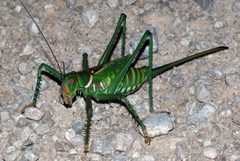
Distinguished from other katydids by its large size, robust build, and predatory . The combination of red , black pronotal margin, heavily spined forelegs, and non-leaf-like wings separates it from all other North American katydids. From the congeneric N. victoria (also in Texas), distinguished by the black vs. green front pronotal edge and red vs. pale eyes. Unlike grasshoppers (Acrididae), has long, many-segmented and a different shape. Unlike shield-backed katydids, lacks the pronotal extensions covering the . The threat display—rearing with wings spread, open, and forelegs raised—is distinctive and memorable.
Images
Appearance
Large, robust with vivid green and yellow body coloration and striking red in life. Lacks the leaf-like wings typical of many katydids; instead possesses relatively short, spotted hind wings. Forelegs are elongate and heavily spined, adapted for prey capture. are massively robust and prominent. Females possess a long, dagger-like ovipositor. Pronotum has a distinctive black front edge (diagnostic from N. victoria, which has green). After death, green coloration fades to dull yellow or brown, though reddish tints may persist in the eyes.
Habitat
Inhabits oak-juniper woodlands and arid-land desert scrub with mesquite or other brush vegetation. Found in sotol grasslands, transitional zones between desert and mountain woodlands, and areas with prickly pear cactus. Requires sufficient vegetation structure for stalking prey and concealment.
Distribution
Southwestern United States (Arizona, New Mexico, Texas) and northern Mexico. One of only two Neobarrettia extending north of Mexico; the is otherwise largely restricted to northern Mexico.
Diet
Obligate . Prey includes grasshoppers, other katydids, caterpillars, small frogs, lizards, and any small animal it can overpower. Documented of the endangered black-capped vireo (Vireo atricapilla). Hunts by stalking through underbrush.
Behavior
An active that stalks prey through vegetation rather than ambushing from a fixed position. When threatened, performs an elaborate threat display: rears back on hind legs, spreads spotted hind wings vertically, raises spiny forelegs, opens massive , and exposes brightly colored abdominal venter. Defends itself with powerful bites and strong kicks if pressed. Unusually tolerant of close approach by humans when feeding or resting; one observer noted an individual allowed prolonged photography while buried in cactus flower stamens. Primarily or in activity pattern.
Ecological Role
Apex in its ; occupies a high among arthropods. Controls of other insects and small vertebrates. Documented impact on endangered bird indicates potential significance for conservation management where their ranges overlap.
Human Relevance
Occasionally encountered by entomologists and naturalists; notable for its impressive threat display and willingness to bite if handled. Popular subject for macrophotography due to its striking appearance and dramatic defensive posture. No significant agricultural or economic impact documented.
Similar Taxa
- Neobarrettia victoriaAlso occurs in Texas; distinguished by green (not black) front pronotal edge and pale (not red)
- Pterophylla camellifolia (Common True Katydid)Similar size and green coloration, but herbivorous, with leaf-like wings and unspined forelegs; lacks red and robust
- Orchelimum spp. (Meadow Katydids)Similar general form but smaller, with slender , spined but less robust forelegs, and rather than strictly habits
- Stenopelmatoidea (Jerusalem crickets, king crickets)Similar robust predatory appearance and large , but different shape (more bulbous), different , and not native to North American deserts
More Details
Taxonomic History
revised by Cohn (1965), who established the modern understanding of boundaries and geographic distributions. The species epithet 'spinosa' refers to the spiny forelegs.
Preservation Artifacts
Green coloration fades to yellow or brown after death and pinning; live coloration must be verified from field observations or photographs of living specimens. Red color may persist as reddish tints in preserved material.