
Listroscelidinae
Redtenbacher, 1891
Spiny Predatory Katydids
Genus Guides
2- Neobarrettia(arid-land katydid)
- Phlugis
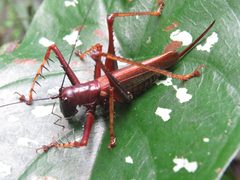
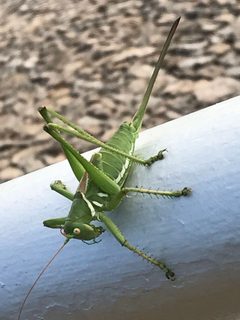
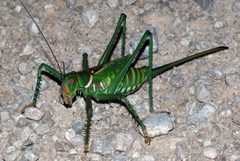
Listroscelidinae is a of predatory katydids (Tettigoniidae) distributed across the Americas, Madagascar, and Australia. Members are characterized by spiny and predatory habits, with enlarged adapted for capturing prey. The subfamily contains multiple tribes including Listroscelidini, Terpandrini, Requenini, Hamayulini, and Conocephalomimini. Several have been described in recent decades, particularly from the Atlantic Forest biome of Brazil and northern Australia. The genus Arachnoscelis gained public attention after appearing on the cover of Science in 2012.
Pronunciation
How to pronounce Listroscelidinae: //ˌlɪs.tɹəˌskɛ.lɪˈdaɪ.ni//
These audio files are automatically generated. While they are not always 100% accurate, they are a good starting point.
Identification
Listroscelidinae can be distinguished from other tettigoniid by spiny body armature, enlarged and often asymmetrical adapted for , and relatively small, roundish, high-set . Members lack the flattened of cone-headed katydids (Conocephalinae) and the more gracile build of many Tettigoniinae. The auditory is present and functional, with size correlating to hearing sensitivity. Preserved specimens typically fade from green to yellow-brown, potentially complicating field identification based on coloration alone.
Images
Habitat
Primarily forested , with greatest diversity in the Atlantic Forest biome of Brazil. Australian representatives occur in north-eastern Queensland rainforests. Some localities are noted as threatened by repeated prescribed burning.
Distribution
Americas (primarily South and Central America), Madagascar, and Australia. In South America, concentrated in the Atlantic Forest biome of southeastern and northeastern Brazil. Australian occur in Queensland.
Diet
Predatory on other insects. Members possess enlarged, heavily sclerotized with sharp, well-defined dentes and incisors adapted for carnivory.
Behavior
Males produce acoustic calls for mate attraction; hearing sensitivity varies with body size and dimensions, with best frequency near 16 kHz. Some exhibit threat displays when disturbed. activity pattern inferred from small size.
Ecological Role
Predatory katydids that function as in forest . Their spiny and predatory habits suggest they occupy a distinct trophic from herbivorous katydids.
Human Relevance
Members of the Neobarrettia, particularly N. spinosa, are known for formidable capable of drawing blood if handled carelessly. Some are subjects of ecological research on and .
Similar Taxa
- Tettigoniinae (shield-backed katydids)Similar body form and brown coloration in preserved specimens, but Tettigoniinae lack the enlarged predatory and spiny armature of Listroscelidinae; many are rather than strictly predatory
- Conocephalinae (cone-headed katydids)Both occur in similar , but Conocephalinae have distinctly flattened and cone-shaped , with more gracile bodies and typically herbivorous or diets
- Stenopelmatoidea (king crickets, Jerusalem crickets)Similar robust build and large create superficial resemblance, but have extremely long relative to body, different wing reduction patterns, and are not closely related within Orthoptera
Sources and further reading
- BugGuide
- Wikipedia
- iNaturalist taxon
- NCBI Taxonomy
- Catalogue of Life
- ID Challenge #2 | Beetles In The Bush
- The Austral Predator Katydid—new species of Megatympanon Piza, 1958 (Orthoptera: Tettigoniidae: Listroscelidinae: Terpandrini) from the Brazilian Atlantic Rainforest
- Studies in Australian Tettigoniidae: New genera and species from North Queensland (Tettigoniidae; Conocephalinae; Armadillagraeciini trib. nov. and Agraeciini; Listroscelidinae; Requenini)
- The Blue Legged Predatory Katydid—a new species of Listroscelis Serville, 1883 (Orthoptera: Tettigoniidae: Listroscelidinae: Listroscelidini) from the Atlantic Rainforest
- New species of Hamayulus Fialho, Chamorro-Rengifo & Lopes-Andrade, 2014 (Orthoptera: Tettigoniidae: Listroscelidinae: Hamayulini) from the Northeastern Brazilian Atlantic Rainforest
- Do large bushcrickets have more sensitive ears? Natural variation in hearing thresholds within populations of the bushcricket Requena verticalis (Listroscelidinae: Tettigoniidae)