
Conocephalus saltans
(Scudder, 1872)
Prairie Meadow Katydid, Western Prairie Grasshopper, Wingless Prairie Grasshopper
Conocephalus saltans, commonly known as the prairie meadow katydid, is a of meadow katydid in the Tettigoniidae. Despite suggesting otherwise, it is not a true but a (bush-). The species is found in North America, with records from states including Alabama, Colorado, Florida, Georgia, Illinois, and others. It belongs to the Conocephalinae, which includes abundant orthopterans of grasslands and prairies.
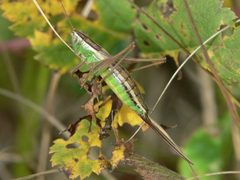
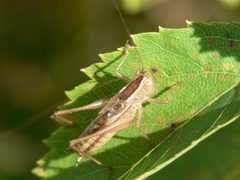
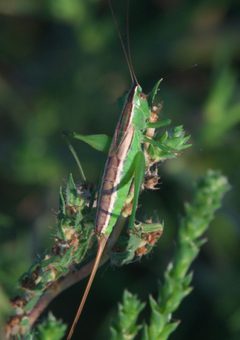
Pronunciation
How to pronounce Conocephalus saltans: /ˌkɒnəˈsɛfələs ˈsɔːltænz/
These audio files are automatically generated. While they are not always 100% accurate, they are a good starting point.
Identification
Distinguished from true grasshoppers ( Acrididae) by extremely long with more than 30 segments, versus short, stubby antennae in grasshoppers. Distinguished from larger meadow katydids in Orchelimum by smaller body size. Distinguished from other Conocephalus by geographic distribution and association with prairies; specific identification requires examination of male genitalia or song characteristics. The 'wingless prairie ' is misleading—this is a , not a grasshopper.
Images
Habitat
Prairie grasslands and meadows. As a meadow katydid in the Conocephalinae, it occupies tall grass including prairies, lush meadows, and similar grass-dominated environments. Specific microhabitat preferences within these systems are not well documented.
Distribution
North America. Documented records from Alabama, Colorado, Florida, Georgia, and Illinois suggest a range spanning the eastern and central United States, with potential western extensions. The full extent of its distribution requires further verification.
Seasonality
Active during summer months, reaching maturity in late summer and early autumn. As with other Conocephalus , are present in September and October, with mating and -laying occurring during this period. stage not confirmed for this species, but related meadow katydids likely overwinter as eggs.
Diet
, feeding primarily on grasses and grass seeds, with supplemental on other insects. As a conocephaline , it possesses powerful enough to crack grass seeds. Observations of related Conocephalus indicate opportunistic predation on smaller insects including leafhoppers, planthoppers, and even conspecifics when injured or vulnerable.
Life Cycle
Hemimetabolous development with , nymph, and stages. Females deposit eggs singly using the ovipositor, inserting them into soil or vegetation. Nymphs resemble miniature adults without fully developed wings. Specific details of egg development timing and nymphal instars not documented for this .
Behavior
Males produce -specific calling songs by stridulation—rubbing a scraper on one forewing against a file on the opposing forewing—to attract females. Females approach males and select mates based on song quality. As with other katydids, individuals are capable of powerful jumping using enlarged hind legs. Activity pattern likely includes both day and evening activity, though specific timing not documented.
Ecological Role
Herbivore and secondary consumer in prairie . Contributes to nutrient cycling through consumption of plant and conversion to insect biomass. Seed may influence plant composition. Serves as prey for various including solitary such as Sphex ichneumoneus, which paralyzes katydids to provision nests.
Human Relevance
Minimal direct economic impact. Contributes to prairie biodiversity and function. May serve as for prairie quality. The is among those documented by citizen scientists, with 375 observations recorded on iNaturalist as of the knowledge cutoff.
Similar Taxa
- Conocephalus brevipennisShares short-winged and prairie meadow ; distinguished by specific song characteristics and geographic distribution overlap.
- Orchelimum spp.Larger meadow katydids in same ; distinguished by greater body size and different song patterns.
- True grasshoppers (Acrididae)Superficially similar and ; distinguished by short , different sound production mechanism (hind leg against forewing), and tympanal ears located on rather than forelegs.
Misconceptions
The 'western prairie ' and 'wingless prairie grasshopper' are taxonomically incorrect—this is a ( Tettigoniidae), not a grasshopper (family Acrididae). The long , forewing stridulation, and foreleg tympanal organs confirm its placement among katydids rather than grasshoppers.
More Details
Taxonomic Note
Originally described as Xiphidium saltans by Scudder in 1872, later transferred to Conocephalus. The specific epithet 'saltans' (Latin for 'jumping') references the saltatorial hind legs characteristic of Orthoptera.
Vulnerability to Parasitoids
Documented as prey of the Great Golden Digger wasp (Sphex ichneumoneus), a solitary that paralyzes katydids to provision underground nest for its larvae.
Sources and further reading
- BugGuide
- Wikipedia
- GBIF taxonomy match
- iNaturalist taxon
- NCBI Taxonomy
- Minstrels of the meadow: Short-winged meadow katydid, Conocephalus brevipennis — Bug of the Week
- The Changing Distributions of our Grasshoppers, Crickets and Relatives - Buglife Blog - Buglife
- Bug Eric: Orthoptera Thursday: The Katydid's Menu
- What’s the difference between a cricket and a grasshopper? - Buglife Blog - Buglife
- Bug Eric: Wasp Wednesday: Great Golden Digger
- Bug Eric: October 2022