
Conocephalus brevipennis
(Scudder, 1862)
Short-winged Meadow Katydid
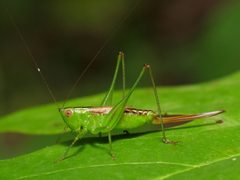
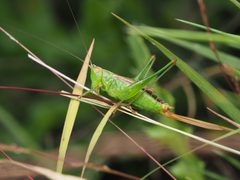
The short-winged meadow katydid (Conocephalus brevipennis) is a small, flightless native to North America and the Caribbean. Males produce -specific stridulations by rubbing forewing structures together to attract mates. Females are distinguished by a prominent sword-like ovipositor used to deposit in protected locations. The species is active primarily in late summer and autumn.
Pronunciation
How to pronounce Conocephalus brevipennis: /kɒnəʊˈsɛfələs brɛvɪˈpɛnɪs/
These audio files are automatically generated. While they are not always 100% accurate, they are a good starting point.
Identification
Distinguished from other Conocephalus by the combination of short wings (not reaching tip) and small body size. The long-winged conehead (Conocephalus fuscus) has wings extending well beyond the abdomen. Other meadow katydids in Orchelimum are larger with proportionally longer wings. The prominent ovipositor in females is diagnostic for sex. Song consists of buzzes and ticks with short pauses, differing from the continuous trill of some relatives.
Images
Appearance
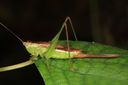
Small green or brown with exceptionally short wings that do not reach the end of the , giving the its . Body typically 15-20 mm in length. long and thread-like, often exceeding body length. Hind legs enlarged and muscular, adapted for powerful jumping. Females possess a prominent, elongated ovipositor projecting from the rear of the abdomen, often nearly as long as the body. Males lack this structure.
Habitat
Tall grassy meadows, wetlands, prairies, and lush grasslands. Prefers areas with dense herbaceous vegetation including grasses and forbs. Often found in moist or humid microhabitats within these open areas.
Distribution
North America: eastern and central United States including Alabama, Arkansas, Florida, Georgia, and northward. Caribbean: recorded from Cuba. Range extends through much of eastern North America with highest densities in mid-Atlantic and southeastern regions.
Seasonality
active primarily August through October in temperate regions. Nymphs develop through spring and summer, reaching maturity in late summer. Mating and -laying occur in autumn. Eggs overwinter in soil or plant tissue.
Diet
: consumes foliage and flowers of grasses and forbs, grass seeds, and occasional animal prey including aphids and other small insects.
Life Cycle
Hemimetabolous development with , nymph, and stages. Eggs deposited by females using ovipositor into soil, plant stems, or under bark. Nymphs resemble miniature adults without wings, molting multiple times through spring and summer. Adults mature in late summer, mate, and females deposit eggs.
Behavior
Males produce stridulatory songs by rubbing a scraper on one forewing against a file on the opposing forewing. Song pattern consists of buzzes and ticks interspersed with short pauses. Females approach male choruses and select mates based on song quality, with the buzz component particularly important for mate choice. Both sexes are capable of powerful jumps using enlarged hind legs to escape . Primarily active during day and evening.
Ecological Role
Human Relevance
Subject of citizen science and natural history observation. Song contributes to autumn soundscape of meadows. No significant agricultural pest status. Used in ecological studies of grassland .
Similar Taxa
- Conocephalus fuscus (Long-winged Conehead)Larger with wings extending well beyond tip; continuous buzzing song rather than buzz- pattern with pauses
- Orchelimum spp. (Greater meadow katydids)Larger body size, proportionally longer wings, more robust build; different song patterns
- Neoconocephalus spp. (Conehead katydids)Much larger (up to 7 cm), cone-shaped , longer wings, powerful capable of painful bite
More Details
Song characteristics
Male song frequency and pattern are -specific; the buzz component of the song is particularly important for female mate choice decisions.
Flightlessness
Short wings render essentially flightless, limiting ability and making dependent on connected patches.
Sources and further reading
- BugGuide
- Wikipedia
- GBIF taxonomy match
- iNaturalist taxon
- NCBI Taxonomy
- Catalogue of Life
- Bembicid Holdings | Entomology Research Museum
- Archive — Bug of the Week
- Minstrels of the meadow: Short-winged meadow katydid, Conocephalus brevipennis — Bug of the Week
- The Changing Distributions of our Grasshoppers, Crickets and Relatives - Buglife Blog - Buglife
- Bug Eric: Orthoptera Thursday: The Katydid's Menu
- What’s the difference between a cricket and a grasshopper? - Buglife Blog - Buglife