
Cyphoderris monstrosa
Uhler, 1864
Great Grig, Monster Haglid
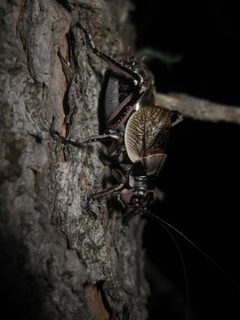
Cyphoderris monstrosa is a relict of hump-winged grig in the Prophalangopsidae, one of only seven extant species in a family with over 90 known fossil species. This small orthopteran inhabits coniferous forests of western North America, where males produce high-pitched trilling calls at sundown to attract mates and defend territories. The species exhibits several unusual traits, including a unique mating ritual in which females feed on male hind wings during copulation, and dual sound-producing structures—males use tegminal stridulation while females and juveniles use the Ander's organ.
Pronunciation
How to pronounce Cyphoderris monstrosa: /ˌsaɪfoʊˈdɛrɪs mɒnˈstroʊsə/
These audio files are automatically generated. While they are not always 100% accurate, they are a good starting point.
Identification
Distinguished from by male subgenital plate with prominent hook. Dark and light ventral coloration pattern aids field recognition in coniferous . Males identified by stridulatory apparatus on tegmina; females and juveniles lack tegminal scrapers but possess functional Ander's organ. Tympanal ears show tonotopic organization with frequency-specific responses.
Images
Appearance
Body length 20–30 mm, weight approximately 1.5 grams. coloration dark brown to black, surface white to beige—coloration thought to provide camouflage against conifer bark. Males possess prominent hook-shaped structure on ventral side of subgenital plate, a key diagnostic feature. Tegmina bear file-like stimulatory organs with rigid dorsal portion angled at 90 degrees to rigid lateral portion. Both sexes possess Ander's organ, present across all life stages. Leg present but less differentiated from regular than in Tettigoniidae.
Habitat
Coniferous forests dominated by lodgepole pine (Pinus contorta) and Engelmann spruce (Picea engelmannii). Occupies bark surfaces of large trees or clumps of trees, where coloration provides camouflage. Males select singing microhabitats on large trees without strong preference for tree .
Distribution
Northwestern United States and southwestern Canada: northern California northward through Oregon, Idaho, Montana to southern Alberta and British Columbia. GBIF records confirm presence in Alberta, British Columbia, Idaho, Montana, and Oregon.
Seasonality
Late instar nymphs overwinter in autumn. emerge in spring, with mating activity concentrated June through August. Males initiate calling at sundown during reproductive period.
Diet
Primarily pollen of coniferous trees; also feeds on flowers and fruits of other plants and occasionally small insects.
Life Cycle
(hemimetabolous development). Late instar nymphs overwinter, emerge as in spring. Specific and early nymphal stages not detailed in available sources.
Behavior
Males produce faint, high-pitched trills described as having 'ventriloquistic nature' beginning at sundown. Calls function in mate attraction and male-male territorial defense. Males facing rivals engage in directed calling with aggressive body language; physical contact occurs but singing duration predicts competitive success. During copulation, females feed on male hind wings—a unique to the and potentially costly to males. Anti- defense includes production of rapid ultrasonic pulses (mean 69.1 pulses/second, peak frequency ~58 kHz, bandwidth 40–90 kHz) via Ander's organ, accompanied by opening and leg kicking when on back.
Ecological Role
Pollen consumer in coniferous forest ; may contribute to pollen transfer. Serves as prey for including bats and birds, with ultrasonic defense suggesting evolutionary pressure from echolocating .
Human Relevance
Subject of scientific research on auditory mechanics and evolution of insect hearing. Tympanal ear structure represents functional intermediate between simple tuned and complex tonotopy of bushcrickets, informing understanding of ear evolution in Orthoptera. Captive maintenance possible on pollen, fresh carrot, and cat biscuits.
Similar Taxa
- Cyphoderris buckelliOverlapping range; females of C. buckelli occasionally mate with young C. monstrosa males to engage in sexual of hind wings, though hybridization does not occur due to postmating reproductive barriers.
- Cyphoderris strepitansCongeneric hump-winged grig with similar and preferences; distinguished by male genitalic differences and geographic distribution.
- Tettigoniidae (bushcrickets/katydids)Superficially similar ensiferan orthopterans with stridulatory communication; distinguished by more differentiated leg , different tegminal file structure, and lack of Ander's organ.
More Details
Auditory System
Tympanal ears exhibit tonotopic frequency discrimination: frequencies below ~8 kHz generate resonant mode, frequencies above ~8 kHz generate travelling waves. Male song pure tone trills at 11–13 kHz, while ear shows maximum displacement at 12.55 kHz (high frequency region) and 5.25 kHz (low frequency region). Notable mismatch exists between ear tuning (~2 kHz lowest sensitivity threshold) and communication frequency, suggesting potential substrate-borne vibration detection role.
Evolutionary Significance
Prophalangopsidae represents ancient lineage of ensiferan Orthoptera with extensive fossil record; C. monstrosa and six are sole survivors, making the group important for understanding evolutionary transitions in and hearing in insects.