
Cyphoderris
Uhler, 1864
Hump-winged Grigs
Species Guides
3- Cyphoderris buckelli(Buckell's grig)
- Cyphoderris monstrosa(Great Grig)
- Cyphoderris strepitans(sagebrush cricket)
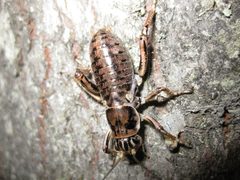
Cyphoderris is a of primitive orthopterans known as hump-winged grigs, representing a relict lineage of the ancient Haglidae (now Prophalangopsidae). These cold-adapted, insects are restricted to high-elevation coniferous forests and sagebrush meadows of western North America. Males produce acoustic signals by rubbing their forewings together to attract females. The genus exhibits unusual reproductive in which females feed on male metathoracic wing tissue during copulation, and males provide substantial proteinaceous . Only three are currently recognized: C. strepitans, C. buckelli, and C. monstrosa.

Pronunciation
How to pronounce Cyphoderris: //ˌsaɪfoˈdɛrɪs//
These audio files are automatically generated. While they are not always 100% accurate, they are a good starting point.
Images
Habitat
High-elevation coniferous forests and sagebrush meadows. Males typically climb into sagebrush bushes to call after emerging from soil litter at sunset. Occurs in mountainous terrain at elevations where sub-freezing temperatures are common during the breeding season.
Distribution
Western North America, specifically in the mountainous regions of Wyoming, Colorado, Montana, Idaho, Alberta, and British Columbia. Disjunct distribution with restricted to specific mountain pockets.
Seasonality
become sexually active in early spring (early May), with mating occurring over a 3-6 week period. Males are capable of stridulating at temperatures below 0°C and have been observed singing at temperatures as low as -8 to -4°C.
Behavior
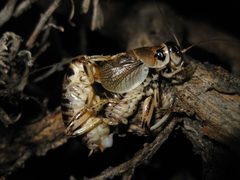
Males are and emerge from soil litter shortly after sunset to climb vegetation and produce calling songs. Males exhibit low site fidelity and extensive displacement between nights, inconsistent with territorial defense. Males respond to nearby song by increasing chirp duty cycle and pulse rate, but do not engage in overt aggression or fighting. During copulation, females mount the male dorsally and feed on his metathoracic wings, ingesting from wounds they inflict. Males possess an abdominal pinching organ that secures the female during transfer to prevent premature dismounting.
Similar Taxa
- ProphalangopsisThe only other extant in the Prophalangopsidae; known from a single specimen collected in Asia before 1900, distinguished by Asian distribution and lack of detailed behavioral data
- ParacyphoderrisRelated in Prophalangopsidae found in the Amur region of Asia; distinguished by Palearctic distribution
- Tettigoniidae (katydids)Modern relatives derived from the same ancient lineage; distinguished by more derived , different acoustic , and lack of wing-feeding behavior
- Gryllidae (crickets)Modern relatives with stridulatory communication; distinguished by different wing , typically higher calling temperatures, and absence of female wing-feeding
More Details
Reproductive Investment
Males make substantial reproductive investments through two routes: metathoracic wing tissue that females consume during copulation, and large proteinaceous that females consume hours after mating. Virgin males have higher mating success than non-virgin males, likely because they possess more wing material and larger reproductive accessory glands capable of producing full-sized spermatophores.
Evolutionary Significance
The represents one of the few extant lineages of Haglidae, a abundant during the Triassic and thought to have given rise to modern crickets and katydids. The family is otherwise known almost exclusively from fossil remains.
Acoustic Behavior
Males increase chirp duty cycle in response to nearby singers, but this functions to maintain relative attractiveness to females rather than in aggressive territorial defense. Unlike many acoustic orthopterans, females have not been demonstrated to exhibit phonotaxis to broadcast song in field or laboratory conditions.
Sources and further reading
- BugGuide
- GBIF taxonomy match
- iNaturalist taxon
- NCBI Taxonomy
- Catalogue of Life
- Acoustic Behavior in Cyphoderris strepitans
- Biology and Reproductive Behaviour of Cyphoderris strepitans
- Cyphoderris Strepitans (Orthoptera, Haglidae): Reproductive Behavior, Singer Movement and Predation
- Cyphoderris Strepitans (Orthoptera: Haglidae): Reproductive Biology and Geographical Distribution
- The Effect of Mating on Calling in Cyphoderris strepitans
- Time-Laspe Video Study of Mating Behavior in Sagebrush Crickets (Cyphoderris strepitans)
- Figure 4: Distribution of waiting times to mating for female sagebrush ( Cyphoderris strepitans ) crickets randomly assigned to either a low-nutrient ( starved ) or high-nutrient ( fed ) diet.
- Reproductive Biology of Cyphoderris strepitans: Copulatory Behavior and the Effect of Nuptual Feeding on Male Acoustic Activity
- Mating and its effect on acoustic signalling behaviour in a primitive orthopteran, Cyphoderris strepitans (Haglidae): the cost of feeding females
- Phylogenetic relationships within hump-winged grigs, Cyphoderris (Insecta, Orthoptera, Tettigonioidea, Haglidae)
- Calling-song function in male haglids (Orthoptera: Haglidae,Cyphoderris)
- Coping with the cold: temperature and mating activity of male sagebrush crickets Cyphoderris strepitans (Orthoptera: Haglidae)
- Geographical Distribution and BiologicalObservations of Cyphoderris(Orthoptera: Haglidae)With a Description of a New Species
- The Mysterious Amurian Grig Paracyphoderris erebeus Storozhenko, 1980 (Orthoptera: Prophalangopsidae): New Data on Its Distribution, Ecology and Biology.