
Prophalangopsidae
Kirby, 1906
grigs, primitive katydids
Genus Guides
1- Cyphoderris(Hump-winged Grigs)
Prophalangopsidae is the sole extant of the ancient superfamily (Orthoptera). The family comprises a small number of relict in North America and Asia, alongside numerous extinct known from Jurassic and Cretaceous deposits. Extant members are known as "grigs" in North America. The family diverged from its closest living relatives, the katydids (Tettigoniidae), over 230 million years ago during the Permian, making it one of the most phylogenetically isolated orthopteran lineages. Fossil evidence documents substantial diversity during the Middle Jurassic to Early Cretaceous, with sparse records thereafter.

Pronunciation
How to pronounce Prophalangopsidae: /prɒfəˌlæŋɡəpˈsɪdiː/
These audio files are automatically generated. While they are not always 100% accurate, they are a good starting point.
Images
Habitat
Extant inhabit montane environments. North American grigs (Cyphoderris) occur in montane forests and subalpine zones. The Asian species Paracyphoderris erebeus occupies subalpine zones at 500–1650 m elevation, favoring open rocky places with reindeer lichen (Cladonia rangiferina) in elfin woodland and larch forest.
Distribution
Extant distribution is highly disjunct: one (Cyphoderris) in northwestern North America (Alberta, British Columbia, and adjacent United States), and four genera in Asia (China, Indian subcontinent, and Siberia). The Siberian Paracyphoderris erebeus is known from the Khabarovsk Territory and Jewish Autonomous Region of the Russian Far East. Fossil distribution spans the Northern Hemisphere, with Jurassic and Cretaceous records from China, Germany, Russia, Kazakhstan, Kyrgyzstan, United Kingdom, Mongolia, Brazil, and New Zealand.
Seasonality
of Paracyphoderris erebeus are active from June until the onset of cold weather; the overwinters as nymphs. North American Cyphoderris species show allochronic separation, with C. buckelli breeding earlier than C. monstrosa.
Diet
Paracyphoderris erebeus feeds on understory plant blossoms in spring, notably lingonberry (Vaccinium vitis-idaea), and on staminate cones of elfin trees prior to pollen release in June. Diet of other extant is not documented in available sources.
Life Cycle
Overwinters as nymphs. emerge in early summer. Oviposition occurs on the ground surface using a very short, nearly ovipositor, likely in chambers prepared by the female.
Behavior
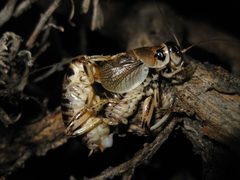
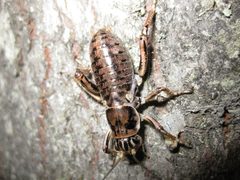
Males stridulate to attract females. In Paracyphoderris erebeus, males call on sunny days from tree trunks at 30–40 cm height or from reindeer lichen. The exhibits a distinctive mating system involving sexual : females consume the fleshy hindwing lobes of males during copulation. Males lacking these lobes possess modified cuticular structures ("gin trap") to grasp the female . The family possesses the Ander's organ, an anti- structure producing ultrasound. Females and nymphs are cryptic, hiding under stones and becoming active in evenings; males are more surface-active in sunny conditions.
Ecological Role
The represents a relict lineage of ancient orthopterans, potentially serving as an indicator of humid montane with relatively low summer temperatures. The extreme phylogenetic isolation of extant makes the family significant for studies of orthopteran evolution and .
Human Relevance
Extant are obscure and rarely encountered due to limited distribution and cryptic habits. Climate modeling for Paracyphoderris erebeus suggests potential vulnerability to warming, with prospective Red List status. No economic or agricultural significance is documented.
Similar Taxa
- Tettigoniidae (katydids/bush-crickets)Closest living relatives, but distinguished by over 230 million years of independent evolution; prophalangopsids retain more ancestral characteristics and exhibit the unique sexual of male hindwing lobes not found in katydids
- Gryllacrididae (camel crickets)Both were historically confused in keys; prophalangopsids possess wings and auditory organs on the fore tibiae, while camel crickets are usually wingless with strongly arched backs and lack tibial auditory organs
Sources and further reading
- BugGuide
- Wikipedia
- GBIF taxonomy match
- iNaturalist taxon
- NCBI Taxonomy
- Catalogue of Life
- Grasshoppers of Wyoming and the West
- Does hunger lead to hybridization in a genus of sexually cannibalistic insects (Orthoptera: Prophalangopsidae)?
- The Mysterious Amurian Grig Paracyphoderris erebeus Storozhenko, 1980 (Orthoptera: Prophalangopsidae): New Data on Its Distribution, Ecology and Biology
- A review of Chifengiinae (Insecta: Orthoptera: Prophalangopsidae) with description of new Jurassic material from the northwestern Junggar Basin, China