
Cyphoderris buckelli
Hebard, 1934
Buckell's grig
Cyphoderris buckelli is a cold-adapted, hump-winged ( Prophalangopsidae) found in high-elevation coniferous forests of western North America. Males produce acoustic calling songs and modify their chirp duty cycle in response to nearby males, though they do not defend fixed territories. The exhibits low site fidelity and extensive male displacement between nights.


Pronunciation
How to pronounce Cyphoderris buckelli: /ˌsaɪfoʊˈdɛrɪs bʌˈkɛli/
These audio files are automatically generated. While they are not always 100% accurate, they are a good starting point.
Identification
Distinguished from C. monstrosa and C. strepitans by morphological characters used in phylogenetic analysis; C. buckelli represents the sister to the clade containing those two . Precise field identification likely requires examination of male genitalia or wing venation patterns.
Images
Appearance
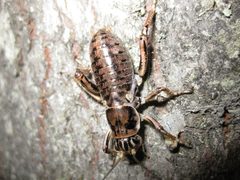
As a hump-winged grig, possesses the characteristic elevated wing structure that gives the group its . Specific morphological details distinguishing C. buckelli from have been documented in phylogenetic studies using 29 morphological characters.
Habitat
High-elevation coniferous forests of western North America.
Distribution
Western North America: British Columbia, Idaho, Montana, Oregon, and Washington.
Behavior
Males produce stridulatory calling songs. When exposed to male song, males increase chirp duty cycle and pulse rate without changing carrier frequency. Exhibits low site fidelity and extensive male displacement between successive nights; does not defend topographically fixed singing territories and shows no fighting between males.
Similar Taxa
- Cyphoderris monstrosaLarger with which it shares ; differs in male as C. monstrosa decreases call duty cycle in response to noise and shows different patterns of aggression-related song modification.
- Cyphoderris strepitansSister within the same clade; distinguished by morphological characters used in phylogenetic analysis.
More Details
Acoustic communication
Male calling songs function in mate attraction rather than territorial defense, as evidenced by the absence of fighting and lack of site fidelity. Chirp duty cycle modification in response to competing males serves to maintain relative attractiveness to females rather than mediate overt aggression.
Phylogenetic position
Molecular and morphological analysis places C. buckelli as sister to the clade containing C. strepitans and C. monstrosa, making it the most basal of the three extant Cyphoderris .