
Cyphoderris strepitans
Morris & Gwynne, 1978
sagebrush cricket, sagebrush grig
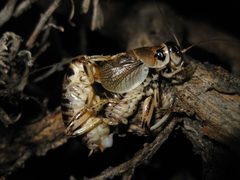
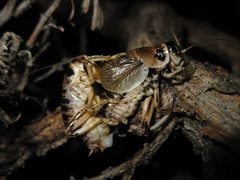
Cyphoderris strepitans is a primitive orthopteran and one of few surviving members of the Prophalangopsidae, a relict group known primarily from fossils. The is to the mountains of Wyoming and Colorado, where males produce loud calling songs by stridulation to attract females. A notable feature of its reproductive is sexual during mating, where females consume the male's fleshy hind wings and , and subsequently a proteinaceous . Males experience significant energetic costs from this feeding, reducing their ability to call and remate. The species is cold-adapted and capable of singing at temperatures as low as -8°C.
Pronunciation
How to pronounce Cyphoderris strepitans: //ˌsaɪfəˈdɛrɪs ˈstrɛpɪtænz//
These audio files are automatically generated. While they are not always 100% accurate, they are a good starting point.
Identification
Distinguished from C. buckelli by male terminalia . Distinguished from C. monstrosa by cream-white venter (vs. vivid pink) and rounded sternal process (vs. angular). Virgin males can be identified by intact hind wings; non-virgin males have damaged or partially consumed wings from prior matings.
Images
Habitat
High-elevation sagebrush steppe and subalpine forests. Occurs in sagebrush meadows at elevations where cold temperatures persist into spring.
Distribution
to mountainous regions of Wyoming and Colorado, USA. Documented in Grand Teton National Park and Yellowstone National Park. Overlaps with C. monstrosa in southern Montana but considered from other Cyphoderris .
Seasonality
become sexually active in early to mid-May. Mating season extends through June, lasting approximately 3–6 weeks under favorable conditions. Activity period is narrowly constrained to spring months.
Diet
Staminate flowers, pollen, fruit, and small insects.
Life Cycle
. Assumed two-year with as late-instar nymphs or young underground during first year. Detailed developmental stages poorly documented.
Behavior
. Males emerge from soil litter shortly after sunset, climb into sagebrush, and sing to attract females. Singing occurs from dusk until late night. Females exhibit phonotaxis toward male calls. Males use an abdominal pinching organ (gin trap) to secure females during copulation. Virgin males sing for significantly longer durations than recently mated males. Males do not exhibit thermoregulatory ability; thoracic temperature tracks ambient temperature.
Similar Taxa
- Cyphoderris buckelliSimilar ; distinguished by male terminalia structure.
- Cyphoderris monstrosaOverlaps in southern Montana; distinguished by vivid pink venter (vs. cream-white), angular sternal process (vs. rounded), and different male terminalia.
More Details
Acoustic Signaling
Produces a trill sound by tegminal stridulation at peak frequency of 12.7 kHz and sound level of 100.5–101.0 dB. Both forewings bear mirror-image file and scraper structures; during stridulation, files from both wings are used. Wing overlap can change throughout lifetime, unlike Gryllidae where right wing consistently overlaps left. Capable of singing at temperatures as low as -8°C, unusually low for Orthoptera.
Nuptial Gifts and Sexual Cannibalism
Male hind wings are specially adapted for consumption by females during mating. This sexual is believed to keep females occupied during insemination. Males also transfer a with an external (gelatinous nutrient ball) that females consume. These provide nutrients that increase female production and egg size.
Mating Costs
Males lose approximately 10% of total body weight during copulation due to loss and wing consumption. Energy trade-offs occur between immune response (repairing damage, preventing ) and (singing, production). Mated males show reduced calling duration and lower remating success compared to virgins.
Sources and further reading
- BugGuide
- Wikipedia
- GBIF taxonomy match
- iNaturalist taxon
- NCBI Taxonomy
- Catalogue of Life
- Acoustic Behavior in Cyphoderris strepitans
- Biology and Reproductive Behaviour of Cyphoderris strepitans
- Cyphoderris Strepitans (Orthoptera: Haglidae): Reproductive Biology and Geographical Distribution
- Cyphoderris Strepitans (Orthoptera, Haglidae): Reproductive Behavior, Singer Movement and Predation
- The Effect of Mating on Calling in Cyphoderris strepitans
- Time-Laspe Video Study of Mating Behavior in Sagebrush Crickets (Cyphoderris strepitans)
- Reproductive Biology of Cyphoderris strepitans: Copulatory Behavior and the Effect of Nuptual Feeding on Male Acoustic Activity
- Coping with the cold: temperature and mating activity of male sagebrush crickets Cyphoderris strepitans (Orthoptera: Haglidae)
- Figure 4: Distribution of waiting times to mating for female sagebrush ( Cyphoderris strepitans ) crickets randomly assigned to either a low-nutrient ( starved ) or high-nutrient ( fed ) diet.
- Mating and its effect on acoustic signalling behaviour in a primitive orthopteran, Cyphoderris strepitans (Haglidae): the cost of feeding females