
Phyllopalpus
Uhler, 1864
handsome trig, red-headed bush cricket
Species Guides
1- Phyllopalpus pulchellus(Red-headed Bush Cricket)
Phyllopalpus is a of small, colorful winged bush crickets in the Trigonidiidae. The genus contains approximately six described distributed across the Americas, with P. pulchellus being the most well-known and widespread in North America. Members are distinguished by their striking coloration, enlarged maxillary palps, and arboreal habits. The genus was established by Uhler in 1864.
Pronunciation
How to pronounce Phyllopalpus: /ˌfɪloʊˈpælpəs/
These audio files are automatically generated. While they are not always 100% accurate, they are a good starting point.
Identification
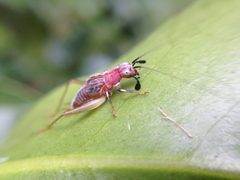
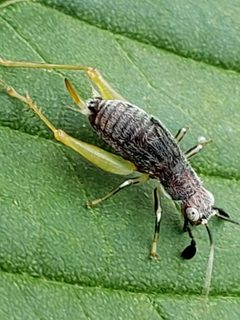
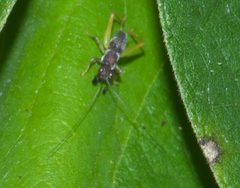
Most easily recognized by the greatly expanded, paddle-like terminal segment of the maxillary palps, which are in constant motion. P. pulchellus exhibits bright red and with black wings and pale legs. Females possess convex, shiny forewings resembling and a prominent sickle-shaped ovipositor. Males have more typical -like forewings modified for sound production, with one wing clear and the other black—a distinctive asymmetry. Body length approximately 7-9 mm.
Images
Habitat
Vegetation in low shrubs and bushes, typically about one meter above ground. Often found near streams, marshes, and swampy areas with stands of mallow and other flowering plants.
Distribution
North America from southern New England to northern Florida and west to eastern Kansas, Oklahoma, and Texas. Records also from Mexico, Central America ( Rica), and South America (Brazil).
Seasonality
active mid- to late summer, primarily July through September.
Behavior
and activity. Males produce loud, high-pitched trilling songs by elevating forewings to nearly vertical position, often selecting locations between two leaves to amplify sound. Both sexes exhibit constant, frenetic movement of the enlarged maxillary palps while on vegetation.
Human Relevance
P. pulchellus commonly encountered by naturalists and photographers due to its distinctive appearance. Occasionally found indoors, where its loud song draws attention. Range expansion has been documented in northeastern North America, with increasing observations in New England and the Great Lakes region.
Similar Taxa
- Gryllidae (true crickets)Ground-dwelling habit, larger size, and lack of enlarged palps; Phyllopalpus is arboreal with distinctive 'boxing glove' palps
- Other TrigonidiidaeSome trigs share small size but lack the bright red-and-black coloration and highly modified palps of Phyllopalpus
More Details
Mimicry hypotheses
The enlarged palps may represent of chemically-defended ground beetles (Carabidae), though this is debated. Alternative hypothesis suggests mimicry of jumping spider . Neither explanation fully accounts for all observed traits.
Taxonomic note
Sometimes placed in Gryllidae rather than Trigonidiidae in older literature; current consensus places in Trigonidiidae.
Sources and further reading
- BugGuide
- Wikipedia
- GBIF taxonomy match
- iNaturalist taxon
- NCBI Taxonomy
- Catalogue of Life
- My, what busy palps you have! | Beetles In The Bush
- Bug Eric: Red-headed Bush Cricket
- Kentucky | Beetles In The Bush
- Gryllotalpidae | Beetles In The Bush
- Mating Behavior ofPhyllopalpus pulchellusUhler (Orthoptera: Gryllidae: Trigonidiinae)