
Phyllopalpus pulchellus
Uhler, 1864
Red-headed Bush Cricket, Handsome Trig, Handsome Bush Cricket
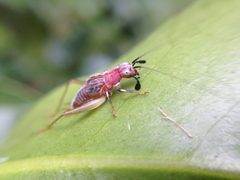
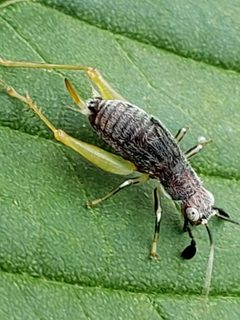
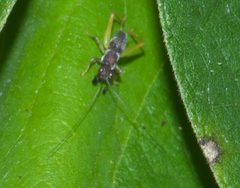
Phyllopalpus pulchellus is a small, colorful in the Trigonidiinae, notable for its striking red and contrasting with dark wings and pale legs. are active during mid- to late summer and are among the most frequently photographed North American crickets due to their distinctive appearance. The species exhibits several unusual traits including sexually dimorphic wing , enlarged paddle-like maxillary palps of uncertain function, and a loud, high-pitched trilling song.
Pronunciation
How to pronounce Phyllopalpus pulchellus: /ˌfɪloʊˈpælpəs pʊlˈkɛləs/
These audio files are automatically generated. While they are not always 100% accurate, they are a good starting point.
Identification
Easily distinguished from all other North American orthopterans by the combination of red and , black wings, pale legs, and enlarged paddle-like maxillary palps. Females can be identified by convex, shiny forewings and sickle-shaped ovipositor; males by asymmetrical forewings with clear spot on left wing. The loud, rattling trill is also distinctive.
Images
Habitat
Low vegetation in moist near streams and marshes, typically about one meter above ground level. Found in shrubs, bushes, and herbaceous vegetation in swampy areas and riparian zones.
Distribution
Eastern United States, from New Hampshire south to northern Florida and west to eastern Texas, Oklahoma, and Kansas. Range appears to be expanding northward with recent observations in southern Ontario, southern Quebec, and the upper Midwest.
Seasonality
active mid- to late summer (July through September).
Diet
, feeding on flowers, leaves, smaller insects, and insect .
Life Cycle
Females deposit in tree trunks. Juveniles possess enlarged palps similar to , indicating this trait develops before maturity.
Behavior
and activity. Males produce a loud, high-pitched rattling trill to attract mates, often positioning themselves between curved leaves or two leaves to amplify sound projection. Both sexes constantly move their enlarged maxillary palps while , apparently using them to sense chemical properties of surfaces. Males provide to females during courtship; if rejected, males consume the gift.
Ecological Role
feeder on plant material and small arthropods; prey item for various . Potential Batesian mimic of chemically defended beetles or jumping spiders, though this hypothesis remains unconfirmed.
Human Relevance
Frequently encountered by naturalists and photographers due to striking appearance. Occasionally enters buildings, where its loud song can be conspicuous. Not an agricultural pest.
Similar Taxa
- Other Gryllidae (true crickets)Lack red / coloration, have unmodified maxillary palps, and typically ground-dwelling habits
- Other Trigonidiinae (trigs)None combine the distinctive red-black-pale color pattern with enlarged paddle-like palps
More Details
Enlarged maxillary palps
The function of the greatly expanded, constantly moving palps remains unresolved. Two main hypotheses exist: (1) of ground beetle or jumping spider , or (2) sensory function for chemical detection of surfaces. The palps are present in both sexes and in juveniles, ruling out purely sexual functions.
Wing dimorphism in males
Males possess one clear forewing and one black forewing, a trait mentioned in literature but not fully explained. This asymmetry may relate to sound production physics.
Range expansion
Recent observations from Massachusetts, Ohio, Michigan, Indiana, Ontario, and Quebec suggest northward range expansion, possibly climate-related.
Sources and further reading
- BugGuide
- Wikipedia
- GBIF taxonomy match
- iNaturalist taxon
- NCBI Taxonomy
- Catalogue of Life
- My, what busy palps you have! | Beetles In The Bush
- Bug Eric: Red-headed Bush Cricket
- Kentucky | Beetles In The Bush
- Gryllidae | Beetles In The Bush
- predator avoidance | Beetles In The Bush | Page 2
- Gryllotalpidae | Beetles In The Bush
- Mating Behavior ofPhyllopalpus pulchellusUhler (Orthoptera: Gryllidae: Trigonidiinae)