
Myrmecophilus pergandei
Bruner, 1884
Eastern Ant Cricket
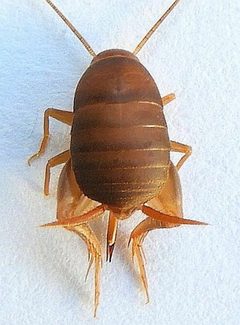
Myrmecophilus pergandei, the eastern , is a wingless orthopteran that lives as an obligate kleptoparasite within ant nests across eastern and central North America. measure approximately 3.85 mm in length and exhibit extreme morphological adaptations for subterranean life, including complete absence of wings and tympanal organs, reduced , and enlarged that serve as primary sensory organs. The has been documented living with at least eleven ant species and takes up to two years to reach maturity.
Pronunciation
How to pronounce Myrmecophilus pergandei: //mɜːrməˈkɒfɪləs pɜːrˈɡændeɪ//
These audio files are automatically generated. While they are not always 100% accurate, they are a good starting point.
Identification
Distinguished from other orthopterans by complete absence of wings and tympanal organs, combined with extremely small size (under 5 mm) and -associated . Oval body form with sunken and large globular antennal bases are distinctive. The two light-colored elliptical pronotal markings are a special feature of this . Separated from other Myrmecophilus species by geographic range (eastern North America vs. western species: M. oregonensis west of Cascades, M. manni in southwestern states, M. nebrascensis in Great Plains). Males distinguished by slightly heavier .
Images
Appearance
Small, wingless with oval body form when viewed from above. Body length approximately 3.85 mm. Coloration primarily ochraceous and with dark brown front margin of pronotum, hind margins of thoracic and abdominal segments, and apex of ovipositor. Two distinctive light-colored elliptical markings on pronotum disc. deeply depressed and sunken into front margin of pronotum. as long as body, with basal joint large and globular, pale yellowish at base transitioning to distally. small, black, composed of ocelli-like , situated immediately behind antennal base and partly concealed by pronotum in dried specimens. greatly enlarged, compressed, ovate incrassate; tibiae stout, shorter than femora, with four movable spines on inner edge and two on outer edge, apex with four long spurs. stout, acuminate, slightly thickest in middle, quite hairy, as long as , slightly heavier in males. Ovipositor slender, larger than usual, with valves of equal lengths.
Habitat
Strictly subterranean, occurring exclusively within nests. Found in underground portions of ant colonies, not in surface foraging trails. specificity tied to ant rather than general environmental conditions.
Distribution
Eastern and central United States. Documented from Colorado, Georgia, Illinois, Louisiana, Maryland, Massachusetts, Mississippi, Nebraska, New Hampshire, New Jersey, New York, Oklahoma, Pennsylvania, and Virginia. Range extends from Maryland south to Florida and west to southern Iowa, eastern Kansas, Oklahoma, and Texas, with recent records from New York and New England.
Seasonality
present throughout the year. Development takes up to two years to reach maturity.
Diet
Kleptoparasitic, feeding on oily secretions from . Has been observed actively licking ants and nest walls to obtain these secretions.
Host Associations
- Lasius umbratus - documented colony associate
- Camponotus castaneus - documented colony associate
- Camponotus chromaiodes - documented colony associate
- Camponotus herculeanus - documented colony associate
- Camponotus novaeboracensis - documented colony associate
- Formica obscuriventris - documented colony associate
- Formica pallidefulva - documented colony associate
- Formica subsericea - documented colony associate
- Aphaenogaster treatae - documented colony associate
- Crematogaster lineolata - documented colony associate
- Tapinoma sessile - documented colony associate
Life Cycle
Development from to takes up to two years. Adults found year-round within colonies.
Behavior
Ecological Role
Kleptoparasite of colonies, obtaining nutrition from secretions without providing known benefits to hosts. Represents a specialized adapted to exploit ant social systems.
Human Relevance
Occasionally found in houses, likely after dispersing from nearby nests. Not a pest ; accidental intrusions into buildings are rare. Presence may indicate nearby carpenter ant or other ant colonies.
Similar Taxa
- Myrmecophilus oregonensisWestern North American ranging from southern British Columbia through Washington, Oregon, and California; distribution separates it from M. pergandei
- Myrmecophilus manniWestern with similar range from southern Washington through California, Nevada, and Arizona; distinguished by geography
- Myrmecophilus nebrascensisGreat Plains ranging from southern California to Texas and north through Colorado, Nebraska, Kansas, and Oklahoma; range overlaps partially but species identity requires morphological examination
More Details
Sensory adaptations
Long and oversized covered in sensory hairs compensate for reduced vision, detecting air currents from approaching or aggressive ants
Size variation
size varies with , ranging from under 1.5 mm to maximum 4.7 mm