
Myrmecophilidae
Saussure, 1874
Ant Crickets, Ant-loving Crickets
Genus Guides
1- Myrmecophilus(ant crickets)
, commonly known as ant crickets or -loving crickets, are a small of Orthoptera comprising fewer than 100 across several . These minute, wingless crickets are obligate that live exclusively within ant nests, where they exhibit specialized morphological adaptations including reduced , elongated , and flattened bodies. The family has a global distribution with records from North America, Europe, Asia, Australia, and Pacific islands, though many species remain poorly documented. Members of this family do not produce sound and lack both wings and tympanal organs.
Pronunciation
How to pronounce Myrmecophilidae: //mɜːrmɛˈkɒfɪlɪdiː//
These audio files are automatically generated. While they are not always 100% accurate, they are a good starting point.
Identification
Distinguished from all other Orthoptera by the combination of: minute size (<5 mm), complete absence of wings in , flattened body form, reduced or absent , and occurrence within nests. Most similar in appearance to nymphs (Blattodea), but can be separated by the enlarged, hair-covered and long, thread-like typical of crickets. Within Orthoptera, superficially resembles nymphs of other Ensifera but lacks wing buds even in mature individuals. Presence within ant colonies is diagnostic; free-living individuals are rarely encountered. -level identification requires examination of genitalia and is challenging due to cryptic diversity.
Images
Appearance
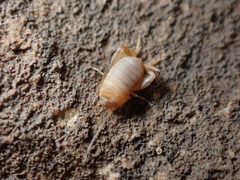
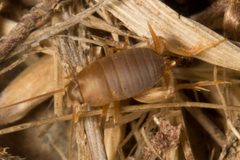
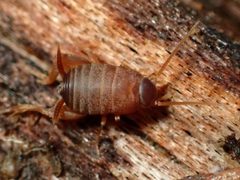
Extremely small crickets, with ranging from less than 1.5 mm to 4.7 mm in maximum length. Body is distinctly flattened dorsoventrally, giving a nymph-like appearance. Coloration varies from yellow and brown to nearly black. are reduced to a small collection of ; ocelli are completely absent. are long, slender, and highly sensitive. are notably enlarged, flared, and covered with sensory hairs that detect air currents. Wings are entirely absent in all life stages. Legs are relatively short and adapted for rapid running in confined spaces.
Habitat
Strictly confined to nests, where they inhabit underground chambers, soil cavities, and nest structures. In Japan, some show differentiation: Myrmecophilus kubotai prefers open habitats while Myrmecophilus kinomurai occupies shaded environments in areas of sympatry. Myrmecophilus orientalis in Greece occurs under stones and in dead wood within open scrubland and pine forests. Some occupy urban areas, as documented for M. americanus in Brazil.
Distribution
Widespread but patchily distributed globally. Documented from North America (including eastern USA from Maryland to Florida and west to Texas; Pacific Northwest; Mexico), Europe (extensive records from Poland, Latvia, Georgia, Greece, including the northernmost known occurrence in Latvia), Asia (Japan with ~10 recognized ; Iran; Siberia with first records suggesting possible status; China; Middle Asia), Australia, Pacific islands (Hawaii, Samoa, New Caledonia/Loyalty Islands, where M. quadrispina is considered introduced), and South America (Brazil with 120-year gap between records). GBIF records additionally indicate presence in Arabian Peninsula and Malesia.
Seasonality
Activity patterns are poorly documented due to subterranean lifestyle. In Poland, Myrmecophilus acervorum shows increased detection in recent years (2011–2022) compared to historical records, though this likely reflects increased survey effort rather than seasonal . have been recorded across various months depending on region; specific seasonal patterns are not established.
Host Associations
- Lasius sp. - Documented for Myrmecophilus acervorum in Siberia
- Camponotus - Large Camponotus of Myrmecophilus orientalis in Greece
- Crematogaster - Small juveniles of Myrmecophilus orientalis
- Lepisiota - Small juveniles of Myrmecophilus orientalis
- Tetramorium tsushimae - Main for Myrmecophilus tetramorii in Japan; association is non-integrated with hostile reactions
- Formicinae - preferred by both M. kinomurai and M. kubotai in Japan
- Paratrechina longicornis - Documented for Myrmecophilus americanus
Life Cycle
Development occurs entirely within nests. Myrmecophilus orientalis exhibits switching during ontogeny: juveniles occur in nests of small ant (Crematogaster, Lepisiota) while inhabit nests of large Camponotus species. In M. quadrispinus, myrmecophily is associated with high longevity but low compared to non-myrmecophilous relatives. Reproductive females are more frequently encountered than males in some ; in Poland, 135 of 138 sex-identified M. acervorum specimens were mature females or female nymphs. Males appear rare or seasonally restricted in some species.
Behavior
Myrmecophilus crickets are remarkably agile, capable of rapid escape from attacks. They have been observed actively "licking" ants and nest walls, presumably feeding on oily secretions from . Ants generally tolerate these crickets minimally and may attack or kill them; M. tetramorii receives consistently hostile reactions from its host Tetramorium tsushimae and lacks intimate such as hosts or receiving seen in some other myrmecophilous . The enlarged with sensory hairs detect air currents from approaching , facilitating escape in darkness. No sound production has been documented; the lacks both wings and stridulatory apparatus.
Ecological Role
Obligate myrmecophiles that occupy a specialized as within colonies. Their role appears to be that of or commensals rather than mutualists, exploiting resources without providing clear benefits. between sympatric (e.g., M. kinomurai and M. kubotai in Japan) drives partitioning, with one species shifting to shaded environments where the other is absent. Some may be introduced (M. quadrispina in Pacific islands; possibly M. acervorum in Siberia), though their impact on native ant is unstudied.
Human Relevance
Occasional accidental encounters in domestic settings when individuals wander from nearby nests, as documented for an Eastern Ant Cricket found in a bathroom. Not considered pests; presence may indicate nearby ant colonies. Scientific interest centers on their specialized myrmecophilous adaptations and evolutionary transitions to obligate inquilinism. Some are subjects of biogeographic and cryptic speciation studies.
Similar Taxa
- Gryllidae (true crickets) Gryllidae possess wings and functional hearing organs (); are wingless with reduced and occur only in nests. Nymphal Gryllidae have wing buds, which Myrmecophilidae lack even as adults.
- Blattodea (cockroaches)Similar flattened body and reduced wing condition in some , but have different cercal structure, shorter relative to body, and are not obligate nest inhabitants. have distinctly enlarged, hair-covered .
- Bothriophylacinae (cave and burrow crickets)Formerly or currently treated within depending on classification; these cave-dwelling crickets share reduced and winglessness but inhabit caves and burrows rather than nests, and show different body proportions.
More Details
Taxonomic History
The has undergone recent taxonomic revision. The Bothriophylacinae, containing cave and burrow crickets, has been variously treated as part of or as a separate lineage. Current classification places Myrmecophilidae within Gryllotalpoidea alongside Gryllidae and Gryllotalpidae.
Cryptic Diversity
Molecular studies indicate ongoing cryptic speciation within Myrmecophilus acervorum, with substantial intraspecific diversity suggesting unrecognized boundaries. This complicates identification and biogeographic interpretation.
Detection Challenges
Due to their minute size, subterranean , and rarity of males in some , are among the most underrecorded Orthoptera. Most records come from deliberate excavation of nests rather than surface sampling.
Sources and further reading
- BugGuide
- GBIF taxonomy match
- iNaturalist taxon
- NCBI Taxonomy
- Catalogue of Life
- Bohart Museum: Ready to Learn More About Grasshoppers, Crickets and Katydids? | Bug Squad
- Bug Eric: OrThoptera Thursday: Eastern Ant Cricket
- Myrmecophilidae (Orthoptera) − a new family for Siberian Fauna
- Distribution of Myrmecophilus acervorum (Panzer, 1799) (Orthoptera: Myrmecophilidae) in Poland
- 120-year gap: new records of Myrmecophilidae (Orthoptera: Ensifera: Gryllotalpoidea) to Brazil
- The ant cricket Myrmecophilus orientalis on the Dodecanese Islands, Greece (Orthoptera: Myrmecophilidae)
- First Record of Ant‐loving Crickets (Orthoptera: Myrmecophilidae: Myrmecophilinae) in New Caledonia
- The northernmost known observation of Myrmecophilus acervorum and the first records of Myrmecophilidae (Orthoptera, Ensifera) from Latvia
- First record of the Ant-loving cricket Myrmecophilus ochraceus for Zakynthos (Greece) with notes on the synonymy of Myrmecophilus salomonis (Orthoptera: Myrmecophilidae)
- Cave and burrow crickets of the subfamily Bothriophylacinae (Orthoptera: Myrmecophilidae) in Iran and adjacent countries
- Two Cleptoparasitic Ant Crickets (Orthoptera: Myrmecophilidae) That Share Similar Host Ant Species Differentiate Their Habitat Use in Areas of Sympatry in Japan
- The Common Ant Cricket Myrmecophilus acervorum (Panzer, [1799]), new to the fauna of Georgia, southern Caucasus ecoregion (Orthoptera: Myrmecophilidae), with additional data on Myrmecophilus hirticaudus Fischer von Waldheim, 1846
- Life history changes associated with myrmecophily: high longevity but low fecundity in a tiny cricket Myrmecophilus quadrispinus (Orthoptera: Myrmecophilidae) living in ant nests
- Differences in Host Specificity and Behavior of Two Ant Cricket Species (Orthoptera: Myrmecophilidae) in Honshu, Japan
- New Records of the Old World Ant Cricket Myrmecophilus americanus Saussure, 1877 (Orthoptera: Myrmecophilidae) in Mexico with an Updated List of Known Ant Hosts for Its New World Congeners
- Development of a non-invasive method for differentiating a new Myrmecophilus species (Orthoptera: Myrmecophilidae) from its closely related host-sharing species
- Nonintegrated Host Association ofMyrmecophilus tetramorii, a Specialist Myrmecophilous Ant Cricket (Orthoptera: Myrmecophilidae)
- Intraspecific diversity of Myrmecophilus acervorum (Orthoptera: Myrmecophilidae) indicating an ongoing cryptic speciation.