
Camponotus herculeanus
(Linnaeus, 1758)
Hercules Carpenter Ant, Hercules ant
Camponotus herculeanus is a large carpenter ant native to northern Eurasia and North America. The excavates nests in damp or decaying wood, including standing trees, stumps, and occasionally structural timbers. Colonies contain multiple wingless queens and three of decreasing size. Workers forage for honeydew from sap-sucking insects and consume insect prey, while also tending larvae of the silvery blue (Glaucopsyche lygdamus). Winged reproductives overwinter in the nest and emerge in spring swarms.
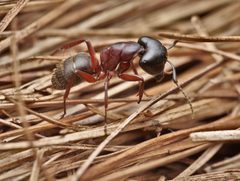
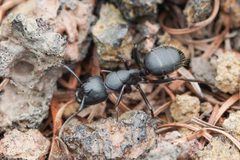
Pronunciation
How to pronounce Camponotus herculeanus: //ˌkæmpəˈnoʊtəs ˌhɜːrkjʊˈliːənəs//
These audio files are automatically generated. While they are not always 100% accurate, they are a good starting point.
Identification
Distinguished from similar carpenter ants by the combination of: three distinct with graded scape-to- ratios; blackish head and contrasting with reddish-brown mesosoma and legs in workers; and association with damp or decaying wood in northern forest . Differs from Camponotus ligniperda in minor morphological details and overlapping but not identical Dufour gland secretion composition. Can be separated from field ants (Formica spp.) by the smoothly rounded thoracic profile in lateral view, lacking the distinct mesonotal impression characteristic of Formica.
Images
Habitat
Occupies conifer and hardwood forests, clearings, oak scrubland, disturbed areas, pastures, and seashore grassland. Common in mountainous regions and northern latitudes where it is often the . Nests are constructed in timber, including living or rotting trees, stumps, fallen logs, and occasionally structural timbers of buildings. Prefers damp wood or timber with fungal decay. In standing trees, tunnels may extend up to 10 m above ground. Satellite colonies may develop in warmer, drier locations nearby, connected to the main nest by underground tunnels.
Distribution
Northern Eurasia from Norway to Eastern Siberia; North America including Canada and the United States. Widespread across most of Europe, Central and Northern Asia. In North America, abundant in mountainous and northern regions.
Seasonality
become active in spring. Winged reproductives are produced in late summer, overwinter in the colony, and emerge to fly in swarms on warm spring days.
Diet
consume honeydew produced by sap-sucking insects such as aphids, and feed on insect larvae encountered during foraging. occurs between workers. Larvae are fed by workers via regurgitated food; they also receive haemolymph and water-soluble protein components from prey. digestion occurs extra-orally via crop regurgitation, while protein and lipid digestion takes place in the .
Host Associations
- Glaucopsyche lygdamus - tended tend larvae of the silvery blue , which often feeds on Lupinus bakeri
- Lupinus bakeri - associated plant of tended larvae
- Myrmecophilus pergandei - commensalAnt cricket sometimes lives in colonies and is tolerated by
- Philonthus rotundicollis - commensalRove beetle overwinters in nests on the coast of the Sea of Okhotsk
Life Cycle
Colonies contain one or several wingless queens, fertile males, and three of sterile (majors, intermediates, minors). Winged reproductives produced in late summer overwinter in the nest. and younger larvae remain in the main nest; satellite colonies house older larvae, pupae, winged reproductives, and workers.
Behavior
excavate wood using strong jaws to create galleries and chambers under bark or within wood. Foraging occurs in the vicinity of the nest. Workers tend sap-sucking insects for honeydew and exhibit . When encountering prey, workers cut the and consume haemolymph and body fluids; they regurgitate crop contents into wounds and reingest the material. Food passage through the digestive tract requires approximately 24-48 hours. Workers prefer sugar solutions over pure water.
Ecological Role
Contributes to wood decomposition through excavation activities in dead and decaying timber. Functions as a of other insects and as a mutualist with honeydew-producing insects and certain larvae. Serves as for myrmecophilous organisms including ant crickets and rove beetles. Acts as a in northern and mountainous forest , influencing local structure.
Human Relevance
Occasionally nests in structural timbers of buildings, particularly where moisture conditions favor damp wood. Can cause damage to wooden structures through excavation of galleries, though less commonly a serious pest than some other carpenter ant . Presence of large (3/8 to 1/2 inch) indoors, especially winged reproductives in spring, may indicate . Management requires locating and destroying colonies, removing damaged wood, and correcting moisture conditions.
Similar Taxa
- Camponotus ligniperdaExtremely similar and ; distinguished by minor morphological details and subtle differences in Dufour gland secretion composition
- Camponotus pennsylvanicusAnother large black carpenter ant; C. herculeanus distinguished by reddish-brown mesosoma and legs in versus more uniformly black coloration in C. pennsylvanicus, and by distribution (C. herculeanus more northern/montane)
- Formica spp.Field ants of similar size; distinguished by thoracic —Formica has distinct mesonotal impression, while Camponotus has smoothly rounded thoracic profile
More Details
Chemical Ecology
Dufour gland secretions contain straight-chain saturated hydrocarbons (C11, C13, C15, C17) with tridecane as the component, plus unsaturated hydrocarbons, branched hydrocarbons, aliphatic alcohols, ketones, and acetates. Hexadecyl acetate is the dominant acetate component. Composition is very similar to that of Camponotus ligniperda.
Colony Structure
Polygynous colonies may contain unrelated queens. Satellite colonies represent a distinctive feature of nesting , allowing the colony to exploit heterogeneous thermal and moisture conditions across the landscape.
Sources and further reading
- BugGuide
- Wikipedia
- GBIF taxonomy match
- iNaturalist taxon
- NCBI Taxonomy
- Carpenter ants here and there: Camponotus spp. — Bug of the Week
- Ant bodyguards here and there: Odorous house ants, Tapinoma sessile, and carpenter ants, Camponotus — Bug of the Week
- Big black ants in the home: Carpenter ants, Camponotus spp. — Bug of the Week
- Formicidae | Beetles In The Bush | Page 2
- Bichos Argentinos #10 – Friday Formicine | Beetles In The Bush
- Amped-Up Ants: Caterpillars' Sugary Treats Earn Carpenter Ant Care
- Effects of drugs on the behaviour of the carpenter ant, camponotus herculeanus
- Similarities between the Dufour Gland Secretions of the Ants Camponotus ligniperda (Latr.) and Camponotus herculeanus (L.) (Hym.)
- FEEDING BEHAVIOUR AND DIGESTION IN CAMPONOTUS HERCULEANUS (L.) (HYMENOPTERA: FORMICIDAE)
- Overwintering ecology of Philonthus rotundicollis (Coleoptera, Staphylinidae) in the nest of the carpenter ant Camponotus herculeanus on the coast of the Sea of Okhotsk