
Tetrix subulata
(Linnaeus, 1758)
Slender Ground-hopper, Slender Groundhopper, Awl-shaped Pygmy Grasshopper, Slender Grouse Locust
Tetrix subulata is a small groundhopper ( Tetrigidae) with a Holarctic distribution spanning the Palearctic and Nearctic regions. The exhibits striking in both coloration and wing development, with long-winged () and short-winged (brachypterous) morphs coexisting in . It is strongly associated with moist , particularly wet meadows, riverbanks, and mudflats, where it feeds primarily on and mosses. The species has been extensively studied for its wing dimorphism, reproductive interference with , and life-history trade-offs between capability and .
Pronunciation
How to pronounce Tetrix subulata: /ˈtɛtrɪks sʌbjuˈleɪtə/
These audio files are automatically generated. While they are not always 100% accurate, they are a good starting point.
Identification
Distinguished from by its slender, elongated pronotum (awl-shaped, hence 'subulata') and small size. Tetrix undulata (Common Ground-hopper) has a broader, more rounded pronotum with wavy lateral margins and tends to occupy drier . Tetrix ceperoi and T. depressa differ in pronotum shape and habitat preferences. Wing length is not diagnostic for identification as both long-winged and short-winged morphs occur. The combination of small size (<15 mm), slender pronotum, and moist habitat association helps distinguish T. subulata from other European Tetrix species.
Images
Appearance
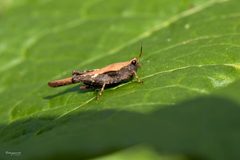
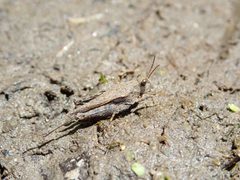
Small groundhopper with body length 9–15 mm. Coloration highly variable, ranging from light grey through brown to very dark or reddish brown; striped morphs also occur. Pronotum elongated and slender (awl-shaped), extending posteriorly over the . Wings polymorphic: long-winged morphs possess fully developed wings capable of , while short-winged morphs have reduced wings and are flightless. Bold white femoral markings often present, contrasting with otherwise cryptic coloration. Hind legs enlarged for jumping, typical of Orthoptera.
Habitat
Primarily associated with moist to wet environments: moist grasslands near streams, riverbanks, mudflats, wet meadows, and flat shores with damp, sun-exposed, open patches. Also recorded in drier grasslands and disturbed , though less frequently. Strongly linked to microhabitats supporting and mosses, which constitute its primary food resources. In the Netherlands, short-winged morphs are more prevalent in grasslands near major rivers, while long-winged morphs dominate in drier, higher elevation landscapes with coniferous forests and heath.
Distribution
Holarctic distribution. Palearctic: widespread across Europe including the British Isles, eastward through Russia to Siberia, and south to North Africa. Nearctic: recorded in North America, including British Columbia. Specific regional records include Albania, Amur region, Austria, Baltic States, and the Netherlands.
Seasonality
present from June–July; -laying occurs from August. stage appears to be egg, with nymphs developing in spring and adults emerging in early summer.
Diet
Feeds primarily on and mosses in damp, sun-exposed, open patches. Diet specialization on these resources is a key factor constraining its requirements.
Life Cycle
stage overwinters; nymphs develop through spring; emerge June–July and oviposit from August. Reproductive output varies among color morphs: black morph females produce more eggs and show faster embryonic development than brown or striped morphs, with egg size consistent across morphs. Wing dimorphism represents a life-history trade-off: long-winged individuals have reduced reproductive output compared to short-winged individuals, consistent with the - .
Behavior
When disturbed, long-winged individuals may fly away readily; short-winged individuals rely on jumping. Courtship involves visual signals: males approach females with a hesitant, waggling gait; receptive females respond by moving hind legs up and down. Exhibits behavioral response to weather cues: moves to dense vegetation when atmospheric pressure drops (potential flood signal), as dense vegetation provides better protection from water flow than moss or bare ground. Cannot climb vertical vegetation to escape flooding due to lack of adhesive structures () on .
Ecological Role
Primary consumer in moist grassland and riparian ; contributes to nutrient cycling through consumption of and mosses. Serves as prey for various . Wing dimorphism creates spatial structure with potential metapopulation dynamics.
Human Relevance
Subject of extensive ecological and evolutionary research, particularly regarding wing , reproductive interference, and life-history trade-offs. Used as a model system for studying the - and spatial sorting of morphological types. Citizen science observations (iNaturalist, GBIF) contribute significantly to research on geographic variation in wing morph frequencies.
Similar Taxa
- Tetrix undulataCommon Ground-hopper; broader, rounded pronotum with wavy lateral margins; prefers drier ; sympatric in western and Central Europe but rarely co-occurs due to reproductive interference and habitat partitioning
- Tetrix ceperoiDifferent pronotum shape and proportions; associated with wet but with distinct microhabitat preferences
- Tetrix depressaFlattened pronotum profile; distinct associations
Misconceptions
Often mistaken for grasshoppers (Acrididae) due to small size; however, Tetrigidae are at this size and represent a distinct . The 'pygmy ' reflects this confusion, though they are not closely related to true grasshoppers in ecological or evolutionary terms.
More Details
Wing Dimorphism and Landscape Genetics
genetic studies in southern Sweden reveal low to moderate genetic diversity within populations and significant divergence among sampling localities, suggesting restricted . Genetic diversity increases with population size and proportion of long-winged morphs on the island of Öland, but not on the mainland, indicating complex interactions between capability, landscape structure, and genetic structure. The open water separating Öland from the mainland acts as a dispersal barrier.
Reproductive Interference
Experimental studies demonstrate incomplete premating isolation with the sympatric sister Tetrix undulata. Heterospecific courtship, mating attempts, and actual matings occur. The interaction is asymmetric: T. subulata experiences reduced copulations in the presence of T. undulata, while T. undulata is unaffected. Males of both species preferentially approach T. undulata females. This reproductive interference may contribute to partitioning between the species.
Flood Avoidance Behavior
Lacks adhesive structures () on , preventing vertical on vegetation—a common anti-flooding strategy in other insects. Instead, responds to dropping atmospheric pressure (flood predictor) by moving to dense vegetation patches, which provide greater resistance to water flow than moss or bare ground. Even relatively low water velocities can dislodge individuals from exposed substrates.
Sources and further reading
- BugGuide
- Wikipedia
- GBIF taxonomy match
- iNaturalist taxon
- NCBI Taxonomy
- Catalogue of Life
- The mini grasshoppers that outlived dinosaurs: the fascinating world of Tetrigidae | Blog
- A “Giant” Pygmy | Beetles In The Bush
- Reproductive life history variation among colour morphs of the pygmy grasshopper Tetrix subulata
- Reproductive Interference between the Common Ground-hopper Tetrix undulata and the Slender Ground-hopper Tetrix subulata (Orthoptera, Tetrigidae)
- Reproductive life history variation among colour morphs of the pygmy grasshopper Tetrix subulata
- Clutch size versus clutch interval: life history strategies in the colour-polymorphic pygmy grasshopper Tetrix subulata
- Effect of substrate on the risk of being washed away by floods for the Groundhoppers Tetrix subulata and Tetrix tenuicornis (Orthoptera: Tetrigidae)
- Specialized Diet and Feeding Habits as Key Factors for the Habitat Requirements of the Grasshopper Species Tetrix subulata (Orthoptera: Tetrigidae)
- Life-history trade-off between macroptery and reproduction in the wing-dimorphic pygmy grasshopperTetrix subulata(Orthoptera Tetrigidae)
- Mapping wing morphs of Tetrix subulata using citizen science data: Flightless groundhoppers are more prevalent in grasslands near water
- Population genetic structure, differentiation, and diversity in Tetrix subulata pygmy grasshoppers: roles of population size and immigration