
Encoptolophus sordidus
(Burmeister, 1838)
clouded grasshopper, dusky grasshopper, dusky locust
Encoptolophus sordidus is a medium-sized band-winged grasshopper native to North American grasslands. are sexually dimorphic in body size, with females substantially larger than males. The exhibits strong dietary specialization for native grasses and sedges, with documented ontogenetic shifts in food preferences between nymphal instars and adults. It is primarily a rangeland species, occasionally reaching status in favorable . The species possesses long wings enabling , and has been observed migrating from depleted rangeland into adjacent crop areas.
Pronunciation
How to pronounce Encoptolophus sordidus: /ɛnˌkɒptoʊˈloʊfəs ˈsɔrdɪdəs/
These audio files are automatically generated. While they are not always 100% accurate, they are a good starting point.
Identification
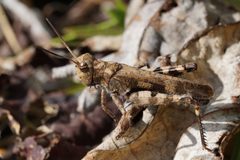
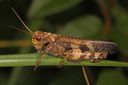
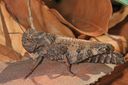
Medium-sized, dark brown to greenish with long wings extending 1–4 mm beyond tip. Tegmina banded; hind wings with weak to occasionally distinct dark bands. Fastigium distinctly longer than wide in males, slightly to distinctly longer than wide in females. Outer surface of hind with three dark bands (weak or absent in green specimens); hind tibia blue. Nymphs identifiable by moderately sloping pronotal disk (not tectate), in instars I–III becoming in IV–V, and four distinct longitudinal ridges on outer of fore- and midleg femora and tibiae with black lines between ridges. Instar I with pink medial area of hind femur in half.
Images
Habitat
Native grasslands including mixedgrass, shortgrass, bunchgrass, and desert prairies. Most abundant in northern mixedgrass prairie. Favors moist areas with rich grass and sedge growth interspersed with bare ground; in southern distribution, occupies mesic swales and roadsides dominated by western wheatgrass, and prairies with heavy clay soils dominated by Texas needlegrass. Also inhabits fine sandy loam soils in mixedgrass prairie.
Distribution
North America, ranging widely in western North America from Canada to Mexico. Documented in Colorado, Wyoming, Nebraska, Kansas, North Dakota, Saskatchewan, Texas, Arizona, and Pennsylvania.
Seasonality
Intermediate-developing . Hatching begins early to mid June in northern mixedgrass prairie, continuing 6–8 weeks. appear August 8–14 in Wyoming and Saskatchewan. In southern distribution (northeastern Texas), adults appear mid April with second by August, and stages present year-round with at least two generations annually.
Diet
Primarily grasses (Poaceae) and sedges (Cyperaceae). Principal plants include western wheatgrass (Agropyron smithii), needleleaf sedge (Carex eleocharis), northern wheatgrass, needle-and-thread (Stipa comata), green needlegrass, and blue grama (Bouteloua gracilis). Additional consumed plants include quackgrass, prairie junegrass, sand dropseed, little bluestem, sideoats grama, Kentucky bluegrass, foxtail barley, and timothy. Forbs consumed sparingly in nature (approximately 1% of diet) but accepted when starved in laboratory; includes alfalfa, scarlet globemallow, prairie coneflower, dandelion, and Vicia sparsifolia.
Life Cycle
stage overwinters. Hatching intermediate in timing relative to other grasshoppers. Nymphal development requires five instars for both sexes, lasting 56–66 days in northern mixedgrass prairie. sexually upon ; require 2–3 weeks growth and maturation before mating. Oviposition may begin by day 16 of adulthood. Females deposit 14–20 tan eggs per pod, 4.0–4.4 mm long, in slightly curved pods approximately 19 mm long. Preferred oviposition substrate is bare ground, particularly Houston black clay soil when available.
Behavior
Geophilus spending nearly all time on ground. resting horizontally on bare soil and litter, often under thin leaf . Basking : 1–2 hours after sunrise, individuals turn side perpendicular to sun and lower associated hindleg to expose for 2–3 hours. Males search for mates on ground; non-receptive females escape by . Males produce flights to arouse females, and single bursts of vibratory stridulation followed by ordinary stridulation pulses when pursuing potential mates. Males often attend ovipositing females but are kicked away. Feeding occurs during midday hours at ground temperatures 76–126°F. At extreme high temperatures (≥125°F), individuals seek partial shade, rest on grass elevated above ground, or climb onto litter facing sun to minimize body exposure. by flight enabled by long wings and strong thoracic muscles; flushed flight softly crepitates, travels 3–9 feet at 3–12 inches height, usually straight with occasional terminal turn.
Ecological Role
Grass-feeder in prairie grassland . Usually subdominant member of , occasionally becoming in favorable (documented at 74% of in some Saskatchewan sites). Selective grazing on preferred grasses and sedges may influence plant composition. typically low (approximately 2.5 young per square yard at peak), with estimated consumption of 1.5–2.4% of grass production. Serves as prey for avian and other .
Human Relevance
Minor economic importance as rangeland . Occasionally reported as minor pest in alfalfa (Arizona, North Dakota) and as pest in fall wheat (Nebraska), where migrated from depleted rangeland into adjacent crops. Susceptible to carbaryl-treated bran (67% mortality in field trials) and malathion ultra-low volume applications. Subject to cooperative control programs in western United States when reach threatening densities.
Similar Taxa
- Chortophaga viridifasciataNymphs appear similar in early instars (I–III), both usually green and structurally similar. Distinguished by (not ) , two distinct longitudinal ridges on fore- and midleg and tibiae (not four), and entirely green hind femur medial area in instar I (not pink in half). Instars IV–V separable by tectate (steep roof-like) pronotal disk with acute angle in C. viridifasciata versus moderately sloping disk with obtuse posterior angle in E. sordidus.
Sources and further reading
- BugGuide
- Wikipedia
- GBIF taxonomy match
- iNaturalist taxon
- NCBI Taxonomy
- Catalogue of Life
- Grasshoppers of Colorado
- Dusky Grasshopper
- Grasshoppers of Colorado
- Grasshoppers of Colorado
- Grasshoppers of Colorado
- Grasshoppers of Colorado
- Food preferences of the dusky grasshopper, Encoptolophus sordidus costalis (Scudder) (Orthoptera: Acrididae)