
Syrbula
Stål, 1873
slant-faced grasshoppers
Species Guides
2- Syrbula admirabilis(Admirable Grasshopper)
- Syrbula montezuma(Montezuma's Grasshopper)
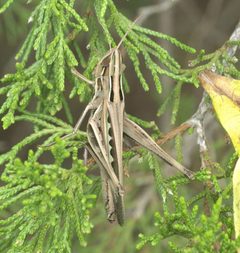
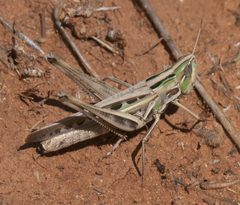
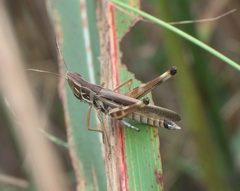
Syrbula is a of slant-faced grasshoppers in the Acrididae, Gomphocerinae. The genus contains at least three described distributed across grassland of North America, from the southern United States through Central America. Syrbula species are notable among grasshoppers for their elaborate courtship , which involves complex visual, acoustic, and chemical signals. Males perform intricate displays including leg movements and stridulation to attract females. The genus includes species such as the admirable (S. admirabilis) and Montezuma's grasshopper (S. montezuma).
Pronunciation
How to pronounce Syrbula: /ˈsɪrbjʊlə/
These audio files are automatically generated. While they are not always 100% accurate, they are a good starting point.
Identification
Members of Syrbula can be distinguished from other Gomphocerinae by their slant-faced , with the slanting backward from the fastigium. The is characterized by long and distinctive pronotal features. Specific -level identification requires examination of male genitalia and subtle differences in coloration and body proportions. The two North American species that occur sympatrically in parts of Texas (S. admirabilis and S. montezuma) can be distinguished by differences in their calling songs, which function in reproductive isolation.
Images
Habitat
Grassland including tallgrass prairie, mixedgrass prairie, and desert prairie. In the western United States, occupies areas with midgrasses and areas receiving additional moisture. Patches of western wheatgrass in swales, around ponds, and along streams are preferred habitats for some .
Distribution
North America from the southern United States (including Alabama, Arizona, Arkansas, Georgia, and Texas) southward through Central America ( Rica). The has been recorded in western states including Wyoming and Colorado.
Seasonality
Late hatching group; hatching begins in early summer. present from mid-summer through fall.
Diet
Feeds primarily on grasses. In tallgrass prairie , associated with midgrass vegetation.
Life Cycle
hatch in early summer. Nymphs develop through multiple instars before reaching adulthood. stage not definitively established for all ; may vary by species and latitude.
Behavior
Exhibits the most elaborate courtship known in grasshoppers. Pair formation occurs through attraction of females to stridulating males, or through reciprocal stridulation and approaching between sexes. Males perform complex visual displays involving synchronous and asynchronous leg movements, acoustic stridulation, and chemical secretions. is pronounced. Males may engage in intermale rivalry including female theft and production of spacing signals. When pairs form through exchange of calling signals, elaborate courtship may be abbreviated; however, males perform full displays when approaching sexually unreceptive females.
Ecological Role
Primary consumer in grassland . Contributes to nutrient cycling through herbivory and serves as prey for various vertebrate and .
Human Relevance
S. admirabilis has been documented as a in some tallgrass prairie , though economic impact appears limited. Not considered a major agricultural pest. Subject of behavioral research due to elaborate communication systems.
Similar Taxa
- ChortophagaBoth are Gomphocerinae with slant-faced ; Chortophaga such as C. viridifasciata share similar preferences in moist grasslands but differ in having greenstriped coloration and less elaborate courtship
- MermiriaSlant-faced grasshoppers in the same tribe (Amblytropidiini) with similar body proportions; Mermiria differ in pronotal structure and lack the complex multimodal of Syrbula
- OrphulellaSlant-faced Gomphocerinae occupying similar grassland ; Orphulella are generally smaller with different antennal proportions and simpler courtship
More Details
Behavioral uniqueness
Syrbula possesses the most elaborate courtship documented in the Orthoptera, involving coordinated visual, acoustic, and chemical signals. This complexity is unusual given that sympatric in similar ecological situations typically exhibit much simpler behavior. The evolutionary causes remain unknown; hypotheses include or specialized female priming requirements.
Reproductive isolation
Where S. admirabilis and S. montezuma occur together in Texas, reproductive isolation is maintained through -specific calling songs. Females respond selectively to male signals, preventing hybridization and reducing wasteful interspecific sexual interactions.
Neural control
The courtship movements of Syrbula show mostly synchronous appendage movements suggesting single-brain command control, but also exhibit asymmetry (different positions and phase relationships between left and right sides), indicating more complex neural control than in European relatives such as Gomphocerus rufus.
Sources and further reading
- BugGuide
- Wikipedia
- GBIF taxonomy match
- iNaturalist taxon
- NCBI Taxonomy
- Catalogue of Life
- Grasshoppers of Colorado
- Grasshoppers of Colorado
- Greenstriped Grasshopper
- Threebanded Grasshopper
- Field Guide
- Grasshoppers of Wyoming and the West
- Simple Versus Elaborate Behavior in Grasshoppers an Analysis of Communication in the Genus Syrbula
- Communicative Behavior of the Grasshopper Syrbula fuscovittata (Thomas) (Gomphocerinae) with Particular Consideration of the male Courtship1