
Syrbula admirabilis
(Uhler, 1864)
Admirable Grasshopper, Handsome Grasshopper, Handsome Locust
Syrbula admirabilis, commonly known as the admirable or handsome grasshopper, is a of slant-faced grasshopper in the Acrididae. It is distributed across Central America and North America, including the southern and central United States. The species inhabits tallgrass prairie and sand prairie , where it has been recorded as a in certain years. It belongs to the late hatching group of grasshoppers, with beginning to hatch in early summer.
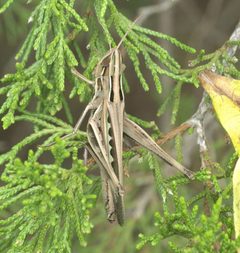
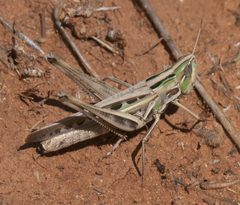
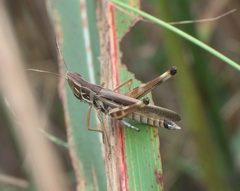
Pronunciation
How to pronounce Syrbula admirabilis: /ˈsɪr.bjuː.lə ædˌmɪ.rəˈbɪ.lɪs/
These audio files are automatically generated. While they are not always 100% accurate, they are a good starting point.
Identification
of Syrbula admirabilis can be distinguished from similar slant-faced grasshoppers by features of the pronotum and general body form. The pronotum has a distinctive shape characteristic of the Syrbula. The is closely related to Syrbula montezuma, with which it shares the genus. Nymphs can be identified by their slant-faced , with diagnostic characters including the degree of facial slope, general color pattern, and shape of the and foveolae.
Images
Habitat
Tallgrass prairie and sand prairie. The has been recorded as a in tallgrass prairie in the Texas Panhandle during certain years.
Distribution
Central America and North America. In the United States, distribution records include Alabama, Arkansas, Georgia, Illinois, and Indiana. The ranges widely across the southern and central United States.
Seasonality
Late hatching group; hatching begins in early summer. This seasonal cycle distinguishes it from earlier-hatching in the same .
Life Cycle
Overwinters as in the soil. Nymphs hatch in early summer and develop through multiple instars before reaching adulthood. Specific details on number of instars and duration of nymphal development have not been documented for this .
Ecological Role
Member of in tallgrass and sand prairie . Has been recorded as a in certain years in the Texas Panhandle shortgrass prairie, where it contributed significantly to grasshopper .
Similar Taxa
- Syrbula montezumaCongeneric sharing the same Syrbula; both are slant-faced grasshoppers in the tribe Amblytropidiini with similar pronotal
- Hadrotettix trifasciatusBoth are recorded as grasshoppers in Texas Panhandle shortgrass prairie in different years; however, H. trifasciatus belongs to Oedipodinae (bandwinged grasshoppers) and can be distinguished by wing structure and hind leg coloration
- Mermiria pictaAnother slant-faced grasshopper recorded as in the same Texas Panhandle in alternating years; differs in pronotal structure and body proportions