
Schistocerca nitens
(Thunberg, 1815)
vagrant grasshopper, gray bird grasshopper
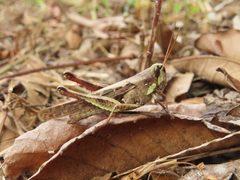
Schistocerca nitens is a large native to southern North America, closely related to the (). are sexually dimorphic in size, with females reaching 60–70 mm and males 40–50 mm. The exhibits mottled gray, brown, and yellow coloration with a distinctive stripe running from to . Unlike true locusts, it does not undergo phase , though dense can occur through favorable conditions rather than behavioral . The species has become in Hawaii, where it caused severe vegetation damage on Nīhoa in 2004.


Pronunciation
How to pronounce Schistocerca nitens: /ˌskɪstəˈsɜrkə ˈnaɪtɛnz/
These audio files are automatically generated. While they are not always 100% accurate, they are a good starting point.
Identification
Distinguished from congeneric by combination of large size, mottled gray-brown-yellow coloration, and prominent -to- stripe. Males require examination of abdominal tip for definitive species identification. Similar to Schistocerca obscura (obscure bird grasshopper) but differs in distribution and subtle morphological features. Distinguished from true locust species by lack of gregarious phase .
Images
Appearance
Habitat
Occupies diverse including desert, woodland, and lower elevation mountainous areas. In native range, found in arid and semi-arid regions of southwestern North America. In Hawaii, thrives in environments lacking natural controls.
Distribution
Native to southern North America: southwestern United States (California to Texas), Mexico, and extending into Central and South America. Vagrant individuals occasionally recorded in Colorado, Utah, Oklahoma, and Nebraska where winter temperatures prevent . in Hawaiian archipelago, established across multiple islands.
Seasonality
active year-round in favorable climates, with reduced activity in winter and fall. Mating occurs on warm summer nights, often around bright lights. -laying in late summer to early fall.
Diet
herbivore; feeds on ornamental plants and various crop . Specific plants include diverse vegetation in invaded Hawaiian .
Life Cycle
Sexual maturity reached at 3–4 months. deposited in soil at 1–2 inch depth in pods containing 20–100+ eggs. All life stages may be present simultaneously throughout year in suitable climates.
Behavior
Capable of long-distance and trans-oceanic . Attracted to artificial light at night. Mating activity concentrated on warm summer nights. Does not exhibit true locust swarming with phase ; dense result from favorable environmental conditions in solitary form.
Ecological Role
Herbivore consuming plant ; in Hawaii, reach densities causing severe vegetation defoliation. Serves as prey for various including birds and arthropods.
Human Relevance
Agricultural pest damaging ornamental and crop plants. in Hawaii causing significant ecological damage, including 90% vegetation loss on Nīhoa in 2004. Subject to control efforts in invaded regions.
Similar Taxa
- Schistocerca obscuraSimilar large size and general appearance; distinguished by distribution (eastern North America) and subtle morphological differences requiring examination of male genitalia
- Schistocerca gregariaClose relative and true locust; distinguished by Old World distribution and capacity for -dependent phase leading to swarming
- Schistocerca americanaCongeneric with overlapping range; distinguished by morphological features and preferences
Misconceptions
Despite dense , this does not exhibit true locust phase . The 2004 Nīhoa event represented high- solitary populations rather than gregarious phase swarming.
More Details
Invasive History
Introduced to Hawaii several decades prior to 2004; spread through archipelago by . on Nīhoa reached extraordinary densities in 2004, destroying approximately 90% of island vegetation. This event demonstrated that high- can occur without locust phase .
Flight Capability
Documented ability to fly at least 300 miles across ocean, facilitating inter-island in Hawaii and occasional vagrant records in continental interior.