
Ischnura verticalis
(Say, 1840)
Eastern Forktail
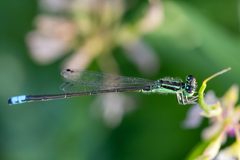
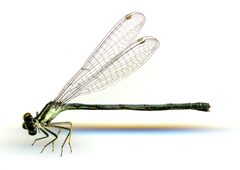
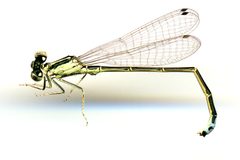
Ischnura verticalis, the Eastern Forktail, is a small in the Coenagrionidae. Larvae exhibit behavioral through depth selection in water columns, moving deeper at higher temperatures and shallower when cooler. Development is temperature- and prey-dependent, with faster development at higher temperatures and food availability. Males typically develop faster than females, with sexual differences in larval and instar progression. emerge over extended periods, with in temperate .
Pronunciation
How to pronounce Ischnura verticalis: /ˈisknʊrə vɜːrtɪˈkaːlɪs/
These audio files are automatically generated. While they are not always 100% accurate, they are a good starting point.
Images
Habitat
Aquatic freshwater environments including ponds, lakes, and slow-moving waters with emergent vegetation. Larvae occupy variable depths depending on thermal and food conditions, with depth selection documented in response to temperature gradients and food availability.
Distribution
North America; recorded from southern Ontario through the northeastern and midwestern United States. Western range extends to Colorado, with documented in Vermont and other eastern states.
Seasonality
on the wing primarily during warmer months; period can extend over 97 days in temperate . with extended adult emergence period.
Diet
Larvae are predatory, feeding on small aquatic . Laboratory studies indicate Daphnia is commonly used prey in captive settings, though natural diet in wild is not explicitly documented in available sources.
Life Cycle
with extended period lasting at least 97 days in some . Larval development includes multiple instars with ontogenetic behavioral changes; larger instars show increased feeding frequency, activity, and distinct behavioral patterns compared to smaller instars. Final instar males develop faster than final instar females. Emergence sex ratio approximately 1:1.
Behavior
Larvae exhibit depth selection : at higher temperatures and abundant food, larvae select deeper waters; at lower temperatures or scarce food, they remain closer to the surface. This represents behavioral balancing growth optimization against risk. Ontogenetic behavioral changes occur through instars, with larger larvae showing increased feeding activity and distinct behavioral repertoires including wave, straight abdomen raise, and rotate + out behaviors. Male larvae in antepenultimate instar are more active and mobile than females. Larvae reduce feeding activity in response to fish , with behavioral response and cost of reduced feeding varying by size.
Ecological Role
in aquatic as larvae; serves as for eugregarine protozoan . Contributes to nutrient cycling and energy transfer between aquatic and terrestrial through .
Sources and further reading
- BugGuide
- GBIF taxonomy match
- iNaturalist taxon
- NCBI Taxonomy
- Catalogue of Life
- Bug Eric: Another Odonata Record
- Bug Eric: New Mexico Dragonfly Blitz - Day 2
- 2018 Arizona Insect Collecting Trip “iReport” | Beetles In The Bush
- Development of Ischnura verticalis (Coenagrionidae: Odonata): Effects of Temperature and Prey Abundance
- Depth selection by larval Ischnura verticalis (Odonata: Coenagrionidae): effects of temperature and food
- Epimerite-Host Epithelium Relationships among Eugregarines Parasitizing the Damselflies Enallagma civile and Ischnura verticalis
- Ontogenetic Behaviour Changes in Larvae of the DamselflyIschnura verticalis(Odonata: Coenagrionidae)
- Diet of nymphs affects normal wing development in Ischnura verticalis (Odonata: Coenagrionidae)
- Sexual differences in development and behaviour of larval Ischnura verticalis (Odonata: Coenagrionidae)
- Effects of size on predation risk, behavioural response to fish, and cost of reduced feeding in larval Ischnura verticalis (Coenagrionidae: Odonata)
- EPIMERITE–HOST EPITHELIUM RELATIONSHIPS AMONG EUGREGARINES PARASITIZING THE DAMSELFLIESENALLAGMA CIVILEANDISCHNURA VERTICALIS
- Macroparasite Population Dynamics Among Geographical Localities and Host Life Cycle Stages: Eugregarines inIschnura verticalis