
Ischnura posita
(Hagen, 1861)
fragile forktail
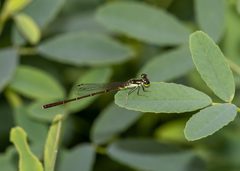
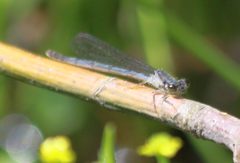
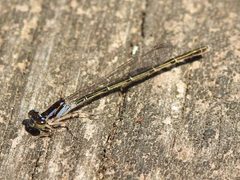
Ischnura posita, commonly known as the fragile forktail, is a small in the Coenagrionidae. It measures 21–29 mm in body length and is native to most of eastern North America. The species is one of the more common damselflies along the east coast of the United States and is readily identified by distinctive exclamation mark-shaped shoulder stripes present in both sexes.
Pronunciation
How to pronounce Ischnura posita: //ɪsˈknjʊrə ˈpoʊsɪtə//
These audio files are automatically generated. While they are not always 100% accurate, they are a good starting point.
Identification
Distinguished from other eastern North American forktails by the exclamation mark-shaped shoulder stripes—other forktails typically show straight, parallel, or differently shaped thoracic stripes. The eastern forktail (Ischnura verticalis) has parallel shoulder stripes. The familiar bluet (Enallagma civile) and other bluets lack the forked abdominal appendages and have different thoracic patterning. Females may be confused with other forktail but the shoulder stripe shape remains diagnostic when visible.
Images
Appearance
Small with body length of 21–29 mm. Both sexes possess shoulder stripes shaped like exclamation marks on the . Males have blue markings on abdominal segments 8 and 9, typically forming a ring around these segments. Females exhibit color , with some individuals displaying blue coloration similar to males (andromorphs) and others showing green or brown tones (heteromorphs). The has the slender characteristic of forktails, with forked appendages at the abdomen tip.
Habitat
Found near a variety of freshwater including ponds, lakes, slow-moving streams, and marshes with emergent vegetation. Tolerates disturbed and artificial water bodies. perch on vegetation near water edges.
Distribution
Native to eastern North America, ranging across most of the eastern United States and southeastern Canada. Records extend westward into parts of the Great Plains. One of the most common on the United States east coast.
Seasonality
are active from spring through fall; season varies geographically but generally April–October in northern parts of range, with longer seasons in southern areas. Multiple per year in warmer climates.
Life Cycle
Hemimetabolous development with , nymph (naiad), and stages. Larvae are aquatic inhabiting shallow waters with vegetation. Nymphs autotomize caudal (external gills) as a defense mechanism against predators. Adults emerge from aquatic nymphs and live approximately six weeks under favorable conditions.
Behavior
Larvae exhibit reduced activity in response to cues in short-term exposure (1 hour), though this effect diminishes over longer periods (8 days). Larval foraging is largely unaffected by sublethal injury such as caudal loss. perch on vegetation near water and engage in territorial behavior. Both sexes are relatively tolerant of observers, allowing close approach.
Ecological Role
Larvae function as intermediate in aquatic , consuming small prey while serving as prey for larger aquatic predators including fish and other odonates. are aerial predators of small flying insects.
Human Relevance
Serves as an for freshwater health due to its specific requirements and sensitivity to water quality. Frequently observed and photographed by naturalists and odonate enthusiasts. Used in ecological research on -prey interactions and injury effects in odonates.
Similar Taxa
- Ischnura verticalisAlso occurs in eastern North America; distinguished by parallel shoulder stripes rather than exclamation marks
- Ischnura ramburiiRambur's forktail has similar size and blue coloration; occurs in overlapping range but has different thoracic stripe pattern
- Enallagma spp.Bluets share blue coloration and but lack forked abdominal appendages and have different thoracic patterns
More Details
Research significance
Ischnura posita has been used as a model organism in studies of sublethal injury effects and -prey interactions in odonates. Research has shown that while larvae autotomize caudal as an antipredator defense, such injuries have minimal long-term impact on foraging or survival.
Color polymorphism
Females exhibit andromorphy (blue male-like coloration) and heteromorphy (green or brown coloration), a trait common in the Ischnura that may relate to male harassment avoidance.