
Enallagma civile
(Hagen, 1861)
Familiar Bluet
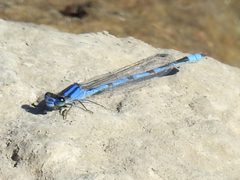
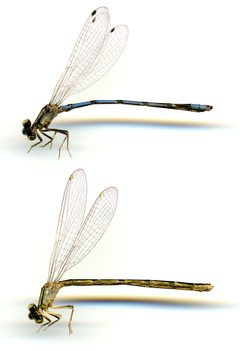
Enallagma civile, commonly known as the familiar bluet, is a narrowwinged native to much of the United States and southern Canada. This is a and predatory insect that has been extensively studied as a model organism for understanding climate change effects on aquatic . Research indicates that rising water temperatures significantly impact its development, survival, and body size, with temperatures above 38°C causing substantial mortality. The species produces multiple per year and serves as to various including Arrenurus water mites and gregarine protozoans.

Pronunciation
How to pronounce Enallagma civile: /ɛnəˈlæɡmə sɪˈvɪli/
These audio files are automatically generated. While they are not always 100% accurate, they are a good starting point.
Images
Habitat
Found in freshwater wetlands, particularly the playas of the southern U.S. plains states—intermittent lakes that periodically dry and recharge with rainfall. Occupies a variety of aquatic including ponds and wetlands in grassland and cropland contexts. Habitat capable of living in diverse conditions.
Distribution
Native to much of the United States and southern Canada. Present in North America, Middle America, Caribbean, South America, and Oceania according to distribution records. Documented from Texas playas and wetlands throughout the Great Plains region.
Diet
Predatory. Both nymphs and are predatory. Nymphs use prehensile foldable lower lip to capture prey.
Host Associations
- Arrenurus water mites - of 38.46% observed; average load ~11 mites per infected
- Actinocephalus carrilynnae - Gregarine protozoan infecting both and naiad
- Eugregarines - Structural interactions documented with epithelium
Life Cycle
to development takes approximately 26 days at 32°C and 33 days at 26°C. Produces multiple per year. Nymphs are aquatic and undergo .
Ecological Role
Serves as an for climate change effects in wetland . Acts as in aquatic . Functions as in within temporally dynamic wetland networks.
Human Relevance
Studied as a model organism for understanding climate change impacts on aquatic . Used in bioassessment research related to wetland health and climate projection studies.
Similar Taxa
- Ischnura verticalisBoth serve as for similar eugregarine with comparable epimerite-host epithelium relationships
More Details
Climate Change Vulnerability
Laboratory studies show drops to 25% at 41°C versus 60-65% at lower temperatures. Nymphs at 41°C experienced 100% mortality by day 4. Warmer temperatures accelerate development but reduce survival and body size.
Parasite Ecology
Land-cover context affects load: cropland playas showed higher mite intensity than grassland playas in one study year, suggesting disturbance influences -parasite dynamics.
Sources and further reading
- BugGuide
- GBIF taxonomy match
- iNaturalist taxon
- NCBI Taxonomy
- Catalogue of Life
- Who Deliberately Runs Over Bee Hives? | Bug Squad
- Dragonfly Enthusiasts, Unite! Open House Set Nov. 6 at Bohart Museum | Bug Squad
- Know Your Dragonflies! | Bug Squad
- Dragonflies! Who Isn't Fascinated by Dragonflies? | Bug Squad
- Bohart Museum Open House: Dragonflies Rule! | Bug Squad
- Rising Temperatures Could Stunt Growth, Threaten Survival of Common Damselfly
- Behavior and Population Structure of the Damselfly, Enallagma civile (Hagen) (Odonata: Coenagriidae)
- Parasitism of Enallagma civile Hagen in Selys, 1853 (Zygoptera: Coenagrionidae) by Arrenurus water mites
- Epimerite-Host Epithelium Relationships among Eugregarines Parasitizing the Damselflies Enallagma civile and Ischnura verticalis
- Effects of Water Temperature Under Projected Climate Change on the Development and Survival of Enallagma civile (Odonata: Coenagrionidae)
- Actinocephalus carrilynnae N. Sp. (Apicomplexa: Eugregarinorida) from the Blue Damselfly, Enallagma civile (Hagen)
- EPIMERITE–HOST EPITHELIUM RELATIONSHIPS AMONG EUGREGARINES PARASITIZING THE DAMSELFLIESENALLAGMA CIVILEANDISCHNURA VERTICALIS