
Enallagma clausum
Morse, 1895
alkali bluet
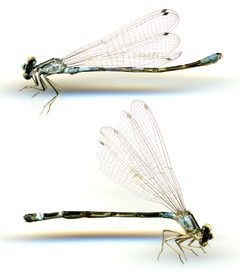
Enallagma clausum, the alkali bluet, is a in the Coenagrionidae. It is native to North America with a documented range expansion westward in western Canada. The has been studied for - dynamics involving water mites and gregarines. Its IUCN conservation status is Least Concern with a stable .
Pronunciation
How to pronounce Enallagma clausum: /ɛnəˈlæɡmə ˈklɔːsəm/
These audio files are automatically generated. While they are not always 100% accurate, they are a good starting point.
Images
Habitat
Standing water in the parklands ecoregion, including cattle dugouts, irrigation canals, waterfowl projects, and power plant-associated water bodies.
Distribution
Native to Manitoba, Saskatchewan, and the northwestern United States; range has expanded westward into Alberta, Canada.
Host Associations
- Arrenurus - water mites
- Gregarines - protozoan
Ecological Role
for including water mites and gregarines. Range expansion may facilitate ecological release for the congeneric Enallagma boreale through apparent parasite preference for the novel E. clausum host.
Similar Taxa
- Enallagma borealeClosely related congeneric that co-occurs in western Canada; distinguished by longer establishment in the region and reduced levels compared to E. clausum.
- Enallagma civileBoth are narrow-winged bluet in the same , but E. civile is a found in the southern Great Plains and playa wetlands, whereas E. clausum is associated with alkaline waters in northern prairie regions.
More Details
Conservation status
IUCN status: Least Concern (). is stable with no immediate threats to survival identified.
Research significance
E. clausum has been used as a model organism to test the enemy release hypothesis regarding range expansion, with findings rejecting the hypothesis due to maintained or elevated loads in expanded range sites.
Sources and further reading
- BugGuide
- Wikipedia
- GBIF taxonomy match
- iNaturalist taxon
- NCBI Taxonomy
- Catalogue of Life
- Dragonfly Enthusiasts, Unite! Open House Set Nov. 6 at Bohart Museum | Bug Squad
- Know Your Dragonflies! | Bug Squad
- Dragonflies! Who Isn't Fascinated by Dragonflies? | Bug Squad
- Bohart Museum Open House: Dragonflies Rule! | Bug Squad
- Hooray for the red, white, and blue! Milkweed longhorned beetle, Tetraopes tetraophthalmus; dogbane tiger moth, Cycnia tenera; and familiar bluet, Enallagma civile — Bug of the Week
- Rising Temperatures Could Stunt Growth, Threaten Survival of Common Damselfly
- Table 3: Results of two-way ANOVA testing for differences between host species and site (Old vs. New) for (A) gregarine prevalence and (B) gregarine intensity infections in Enallagma clausum , a native species whose range is expanding in western Canada, and Enallagma boreale , a closely related long-established species.
- Table 2: Results of two-way ANOVA testing for differences between host species and site (Old vs. New) for (A) Arrenurus prevalence and (B) Arrenurus intensity infections in Enallagma clausum , a native species whose range is expanding in western Canada, and Enallagma boreale , a closely related long-established species.