
Enallagma boreale
Selys, 1875
Boreal Bluet
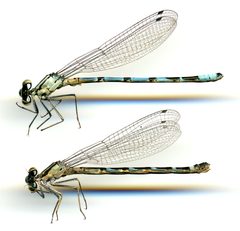
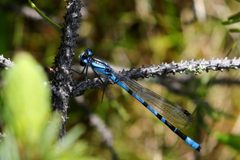
Enallagma boreale, commonly known as the bluet, is a in the Coenagrionidae. It is native to North America and has been long-established in western Canada, particularly in Saskatchewan and Alberta. Research has focused on its - relationships with gregarines and water mites, revealing sex-biased patterns where males typically show higher parasite than females. The species co-occurs with the range-expanding Enallagma clausum, and appears to experience ecological release from parasites when the novel host is present.
Pronunciation
How to pronounce Enallagma boreale: /ɛnəˈlæɡmə boʊˈriːeɪliː/
These audio files are automatically generated. While they are not always 100% accurate, they are a good starting point.
Images
Distribution
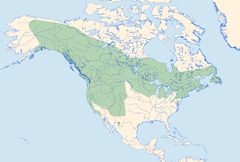
Long-established in western Canada, specifically Saskatchewan and Alberta; also present in Vermont and other parts of North America. The ' range is not currently shifting, unlike its Enallagma clausum.
Host Associations
- gregarines (Apicomplexa: Eugregarinidae) - males show higher (59%) than females (31%); intensity positively correlated with male but negatively with female survivorship
- Arrenurus (water mites) - and intensity studied in comparative context with Enallagma clausum
Life Cycle
Aquatic larval stage followed by terrestrial stage. Larvae of both sexes show high rates by gregarines with no sex difference in or intensity. Newly emerged adults have few or no , with parasite accumulation occurring during adult life.
Similar Taxa
- Enallagma clausumClosely related with which it co-occurs in western Canada; E. clausum is undergoing range expansion while E. boreale is long-established with stable range. The two have been studied together to test the enemy release hypothesis regarding .
- Enallagma civileAnother congeneric bluet with which it shares the Enallagma, though E. civile is a found in playa wetlands of the southern U.S. plains states with different preferences.
More Details
Parasite-mediated interactions
Research suggests E. boreale benefits from ecological release when the novel E. clausum is present, as (water mites and gregarines) may preferentially infest the range-expanding, potentially naïve host rather than the well-established E. boreale.
Sex-biased parasitism
E. boreale show sex differences in gregarine patterns. Males exhibit higher and intensity of infection, yet show positive correlation between load and longevity under food stress. Females show lower infection rates but negative correlation between parasite intensity and .
Sources and further reading
- BugGuide
- GBIF taxonomy match
- iNaturalist taxon
- NCBI Taxonomy
- Catalogue of Life
- Dragonfly Enthusiasts, Unite! Open House Set Nov. 6 at Bohart Museum | Bug Squad
- Know Your Dragonflies! | Bug Squad
- Dragonflies! Who Isn't Fascinated by Dragonflies? | Bug Squad
- Bohart Museum Open House: Dragonflies Rule! | Bug Squad
- Hooray for the red, white, and blue! Milkweed longhorned beetle, Tetraopes tetraophthalmus; dogbane tiger moth, Cycnia tenera; and familiar bluet, Enallagma civile — Bug of the Week
- Rising Temperatures Could Stunt Growth, Threaten Survival of Common Damselfly
- Parasitism of damselflies (Enallagma boreale) by gregarines: sex biases and relations to adult survivorship
- Table 3: Results of two-way ANOVA testing for differences between host species and site (Old vs. New) for (A) gregarine prevalence and (B) gregarine intensity infections in Enallagma clausum , a native species whose range is expanding in western Canada, and Enallagma boreale , a closely related long-established species.
- Table 2: Results of two-way ANOVA testing for differences between host species and site (Old vs. New) for (A) Arrenurus prevalence and (B) Arrenurus intensity infections in Enallagma clausum , a native species whose range is expanding in western Canada, and Enallagma boreale , a closely related long-established species.