
Arrenurus
Dugès, 1834
water mites
Species Guides
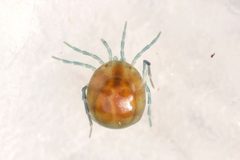
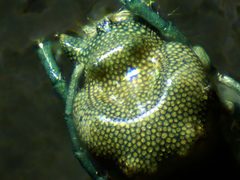
1Arrenurus is the largest of water mites, comprising approximately 950 with distribution in lentic freshwater . are heavily sclerotized, predatory, and exhibit marked —males possess diagnostic caudal modifications used in mating, while female remains problematic. The includes seven stages: , inactive prelarva, parasitic larva, , deutonymph, tritonymph, and adult. Larvae are of aquatic insects, particularly Odonata (dragonflies and damselflies), but also Diptera and Coleoptera, utilizing for both nutrition and phoretic .
Pronunciation
How to pronounce Arrenurus: //əˈrɛn.jʊ.rəs//
These audio files are automatically generated. While they are not always 100% accurate, they are a good starting point.
Identification
Males are readily identified to by their diagnostic caudal modifications used during mating. Females are taxonomically problematic and often cannot be reliably identified to species. Larvae can be recognized by their association with aquatic insect , particularly on the and of odonates. The is distinguished from other water mite genera by the combination of predatory habit, larval on aquatic insects, and male caudal structures.
Images
Appearance
are heavily sclerotized water mites with marked . Males possess modified caudal structures (the 'male tail' referenced in the name) used during mating; these structures are -specific and taxonomically diagnostic. Females lack these modifications and are more difficult to identify. The body is typically compact with a hard . Larvae are minute, mobile, and adapted for ectoparasitism.
Habitat
Lentic freshwater including ponds, wetlands, and standing water bodies; also found in flowing freshwater. are free-living in water. Larvae occur on or within aquatic insect during the parasitic phase.
Distribution
; recorded from every continent except possibly Antarctica, including remote Pacific islands. Specific distribution records include Colombia (Atlántico, Caldas, Cauca, Chocó, Cundinamarca, Meta), Denmark, Norway, and Sweden. The Palearctic A. globator is documented from standing and flowing freshwater throughout that region.
Diet
and deutonymphs are predatory, feeding primarily on Ostracoda (seed shrimp) and likely other small aquatic . Larvae are that feed on tissue fluids of aquatic insects.
Host Associations
- Odonata (dragonflies and damselflies) - larval Primary group; larvae attach to and , less commonly on back, , or wing . Mites move from to soft immediately after .
- Diptera - larval Secondary group
- Coleoptera - larval Secondary group; some parasitize false beetles
Life Cycle
Seven stages: , inactive prelarva, larva, , deutonymph, tritonymph, and . Only the larval stage is parasitic; all post-larval stages are free-living . Larvae attach to during the host's transition from larva to adult, penetrate the dermis, and produce a stylostome (blind sac) to resist host immune response. After engorging, larvae return to water to complete development through nymphal stages to adulthood.
Behavior
males exhibit complex courtship : upon detecting a female (likely via ), males stop swimming, fan their hind legs in rotary motion, and assume a readiness posture with fourth legs crooked and placed flat over the cauda. Females walk with fourth legs moving in rotary motion and may climb onto the male's cauda; the male then maneuvers the female until sperm transfer is completed. Larvae are phoretic, using for to new and gene pool expansion in addition to nutrition.
Ecological Role
and nymphs function as of small aquatic , particularly Ostracoda. Larvae act as of aquatic insects, with documented effects on longevity and through tissue fluid drainage, hampered copulation, and interference with sperm transfer. The phoretic relationship contributes to mite and metapopulation dynamics across freshwater .
Human Relevance
Important research organisms for studying - , freshwater invasion by arachnids, and the evolution of complex . Serve as bioindicators of freshwater quality. Occasionally encountered by naturalists and photographers on dragonflies and damselflies. No direct economic importance documented.
Similar Taxa
- Other water mite genera (Hydrachnidia)Arrenurus is distinguished by the combination of heavily sclerotized , pronounced male caudal modifications used in mating, and primary larval association with Odonata. Many other water mite lack male caudal structures or parasitize different groups.
- Velvet mites (Trombidiidae, Erythraeidae)Terrestrial relatives in Parasitengona; are soft-bodied, often brightly colored, and occur in terrestrial rather than freshwater. Larvae parasitize different groups including harvestmen and other terrestrial arthropods.
More Details
Taxonomic challenges
Female Arrenurus are notoriously difficult to identify to , whereas male is relatively straightforward due to diagnostic caudal modifications. This disparity creates significant challenges for biodiversity assessments and ecological studies.
Stylostome formation
Feeding larvae produce a stylostome—a small blind sac within the 's body—that resists host immune responses including clotting, melanin deposition, and . This specialized structure enables prolonged parasitic feeding.
Phoresy versus parasitism
While larval feeding clearly benefits the mite, the relationship involves significant phoretic (transport) benefits including , access to new , and between . may suffer reduced from .
Sources and further reading
- BugGuide
- Wikipedia
- GBIF taxonomy match
- iNaturalist taxon
- NCBI Taxonomy
- Catalogue of Life
- Mighty Mites! | Bug Squad
- "Go Pick Up a Mite!" Two Cents From an Acarologist and His Love for Mites
- Behavioral evidence suggests the presence of a female-emitted sex pheromone in the water mite species, Arrenurus globator (O. F. Muller, 1776) (Acari: Hydrachnida; Arrenuridae).