
Sympetrum danae
(Sulzer, 1776)
Black Darter, Black Meadowhawk
Sympetrum danae is a small with a northern Holarctic distribution, found in northern Europe, Asia, and North America. It is Britain's smallest resident dragonfly at 29–34 mm long. The is strongly associated with acidic bog and is active from mid-June to mid-November, with peak activity in late summer. Mature males are entirely black, making this the only Sympetrum species lacking red coloration in males.
Pronunciation
How to pronounce Sympetrum danae: /sɪmˈpɛtrəm ˈdɑːniː/
These audio files are automatically generated. While they are not always 100% accurate, they are a good starting point.
Identification
Distinguished from other Sympetrum by mature males being entirely black without any red markings—the only species in the with this trait. The broad base of the hindwings and black pterostigmata are additional diagnostic features. Females may be confused with other darters but show the characteristic black and yellow pattern with three diagonal yellow thoracic bars. The small size (Britain's smallest resident ) and weak, fluttering help separate it from larger Sympetrum species. Distinguished from the black-colored male White-faced Darter (Leucorrhinia dubia) by the absence of a white and burgundy .
Images
Appearance
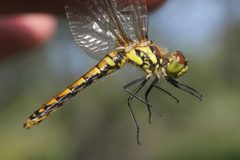
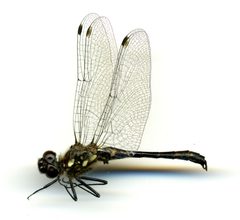
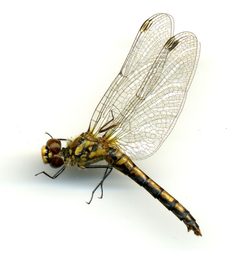
Small with body length 29–34 mm and hindwing 20–30 mm. Both sexes have black legs and black pterostigmata. The is narrowest at the base, widening toward the tip. Wings are transparent with fine black venation, a small black bar on the front edge near the tip, and a very broad base to the hindwings. Mature males are entirely black with no red markings. Younger males show three diagonal yellow thoracic side marks separated by a bold black panel, and yellow abdominal side marks that darken with age. Females and males are patterned black and yellow with three diagonal yellow thoracic bars and extensively yellow upper abdomen, becoming browner with age.
Habitat
Restricted to acidic shallow pools, lake margins, and ditches in lowland heath and moorland bogs. Breeding sites typically contain bog-mosses (Sphagnum) and rushes. The requires cool, acidic water conditions and is sensitive to warming.
Distribution
Northern Holarctic distribution: northern Europe, northern Asia, and northern North America. In the British Isles, locally distributed in lowlands but more widespread in the north and west, and throughout Ireland. Records from the south coast of Britain suggest occasional immigration from the continent.
Seasonality
present from mid-June to mid-November, with peak activity from mid-July to mid-September. Late-season activity is characteristic, persisting well into autumn when many other have declined.
Diet
Life Cycle
are laid in by dipping the tip into water; females select oviposition sites based on visual appearance, temperature (preferring cooler sites), and absence. Eggs hatch the following spring. Larval development is unusually rapid, with possible after as little as two months. The egg development period is approximately 217 days from oviposition to hatching, with seven distinct developmental phases described.
Behavior
is weak and fluttering compared to other Sympetrum . Males are more active in morning hours, spending time searching for females; activity decreases in afternoon. Females are more in early hours and more active later in the day. Males exhibit two flight types: search flight and patrol flight. Males in particular disperse widely and may appear far from suitable breeding . Females visit water primarily for mating or oviposition, otherwise remaining in areas with overgrown vegetation. Males are more active near water bodies.
Ecological Role
Aquatic nymphs function as in bog pool , controlling of other aquatic and small vertebrates. are aerial predators of flying insects. The serves as prey for birds, fish, and other larger predators. As a bog , its presence indicates intact acidic wetland ecosystems.
Human Relevance
Subject to citizen science monitoring and conservation attention due to sensitivity. Climate change poses a significant threat through warming temperatures and altered rainfall patterns affecting bog habitats. Additional threats include development, drainage, agriculture, and peat extraction. The has been studied for oviposition site selection , contributing to understanding of reproductive in .
Similar Taxa
- Sympetrum striolatum (Common Darter)Similar size and preference, but males show red or yellow coloration with pale legs and yellow thoracic patches; distinguished by presence of red in males and pale legs
- Sympetrum corruptum (Variegated Meadowhawk)North American with more robust build, variegated red and yellow patterning in males, and stronger ; does not show all-black mature male coloration
- Leucorrhinia dubia (White-faced Darter)Also inhabits bog pools and has black-colored males, but distinguished by white and burgundy in both sexes, and more robust body shape
More Details
Reproductive anatomy
Females possess two spermathecae and a spherical bursa copulatrix, absent in males. Males have four-segmented genitalia and can remove sperm from previous mates during copulation, replacing it with their own.
Conservation status
Not formally listed as threatened but considered vulnerable due to specialized bog requirements. Climate change is the primary emerging threat, with potential for northward range shifts and declines in southern parts of range.
Sources and further reading
- BugGuide
- Wikipedia
- GBIF taxonomy match
- iNaturalist taxon
- NCBI Taxonomy
- Catalogue of Life
- Lovin' the Lavender | Bug Squad
- The Day That Dragonflies Sprang to Life | Bug Squad
- Beauties in the Bog - Buglife Blog - Buglife
- 🪲 Entomologizing w/ the WGNSS Entomology Group at Hughes Mountain Natural Area — 11 Oct 2025 | Beetles In The Bush
- Citizen Scientists Needed for the Migratory Dragonfly Partnership
- Bug Eric: Shoot First, Ask Questions Later
- Costs and benefits associated with oviposition site selection in the dragonfly Sympetrum danae (Odonata: Libellulidae)