
Celithemis
Hagen, 1861
pennants, small pennants
Species Guides
8- Celithemis amanda(Amanda's Pennant)
- Celithemis bertha(Red-veined Pennant)
- Celithemis elisa(Calico Pennant)
- Celithemis eponina(Halloween Pennant)
- Celithemis fasciata(Banded Pennant)
- Celithemis martha(Martha's Pennant)
- Celithemis ornata(ornate pennant)
- Celithemis verna(double-ringed pennant)
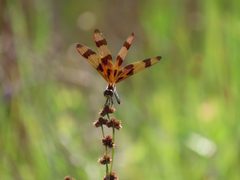
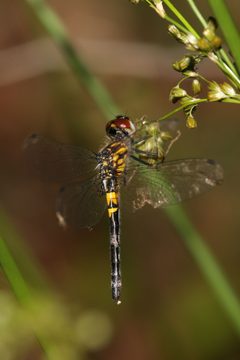
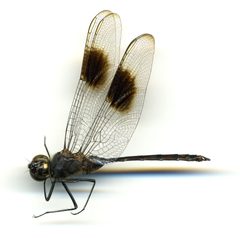
Celithemis is a monophyletic of eight in the Libellulidae, commonly known as pennants or small pennants. Species are primarily distributed in eastern North America. Males of multiple species perch conspicuously on vegetation to defend territories and exhibit resource partitioning through differential perch height selection.
Pronunciation
How to pronounce Celithemis: /ˌsɛlɪˈθɛmɪs/
These audio files are automatically generated. While they are not always 100% accurate, they are a good starting point.
Identification
Small to medium-sized skimmers with relatively slender . Many have distinctive wing patterns including bands or spots. Males often show bright coloration on the body or wings. The can be distinguished from other Libellulidae by combinations of wing venation, abdominal shape, and patterning, though species-level identification requires examination of specific markings and body proportions.
Images
Habitat
Freshwater including ponds, lakes, and wetlands with emergent vegetation that provides perching substrates. Habitats typically have open water adjacent to vegetated margins where males establish territories.
Distribution
Eastern North America, with ranges extending from southern Canada through the eastern United States.
Seasonality
Active from late spring through summer; have been observed from May to July in studied .
Behavior
Males are perch-site faithful, returning to the same elevated perches to defend territories. Multiple co-occurring partition perch heights vertically: larger species perch higher and closer to open water, while smaller species use lower perches. Aggressive interactions occur between conspecifics and heterospecifics, with attack frequency correlating with relative body size and abundance.
Similar Taxa
- LibellulaSimilar-sized skimmers in the same , but Libellula generally have broader and different wing patterning; perch selection differ where they co-occur.
- SympetrumOverlapping use in some regions, but Sympetrum typically have different body proportions and perch lower in vegetation; less territorial perching observed.
More Details
Perch partitioning
Research on three co-occurring (C. elisa, C. eponina, C. fasciata) demonstrates that even small body size differences contribute to partitioning. C. fasciata, the largest species, perches highest and closest to water; C. elisa, the smallest, uses lowest perches. This vertical stratification reduces .
Competitive hierarchy
Interspecific aggression patterns follow a size-dependent hierarchy: larger C. fasciata is attacked less frequently than expected by abundance, while smaller are attacked more frequently, suggesting size-mediated dominance in territorial interactions.
Sources and further reading
- BugGuide
- Wikipedia
- GBIF taxonomy match
- iNaturalist taxon
- NCBI Taxonomy
- Catalogue of Life
- Tests of Preference and Switching Behavior of the Dragonfly Celithemis fasciata
- Perch Selection by Three Cooccurring Species ofCelithemis(Odonata: Libellulidae): Testing for a Competitive Hierarchy among Similar Species