
Celithemis elisa
(Hagen, 1861)
Calico Pennant
Celithemis elisa, commonly known as the calico pennant, is a in the Libellulidae native to eastern North America. are small to medium-sized (24–34 mm body length) with distinctive brown spots at the wing bases and tips. The species inhabits calm freshwater bodies with emergent vegetation and exhibits spatial partitioning of perching microhabitats when co-occurring with .
Pronunciation
How to pronounce Celithemis elisa: //sɛ.lɪˈθi.mɪs ɛˈliː.sə//
These audio files are automatically generated. While they are not always 100% accurate, they are a good starting point.
Identification
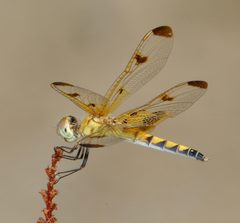
Distinguished from similar Celithemis by the brown spots at wing bases and tips combined with intermediate body size. C. fasciata is larger with different patterning; C. ornata is smaller. Perches at intermediate heights when sympatric with these . Pterostigma color (yellow in young, red in old) and color (yellow to red in older males) provide additional cues.
Images
Appearance
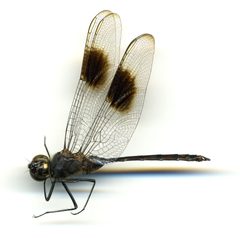
Body length 24–34 mm; hindwing length 25–30 mm. Wings with brown spots at bases and tips. Pterostigma yellow in younger individuals, red in older. yellow, turning red in older males. yellow-brown with large dark stripe and several smaller brown stripes. dark with paler markings.
Habitat
Calm freshwater bodies surrounded by vegetation, including ponds and lakes with emergent vegetation providing perching substrates
Distribution
Eastern Canada and eastern United States
Seasonality
active May to July based on observation records from South Carolina; likely broader season across range
Behavior
Perches on vegetation at heights intermediate between sympatric (lower than C. ornata, higher than C. fasciata), suggesting spatial partitioning of perching microhabitats that may reduce . Males engage in aggressive interactions with conspecifics and congeners.
Similar Taxa
- Celithemis fasciataLarger body size; perches lower and closer to water; different wing patterning
- Celithemis ornataSmaller body size; perches higher; different wing patterning
More Details
Competitive interactions
When co-occurring with C. fasciata and C. ornata, C. elisa occupies an intermediate position in a size-dependent competitive hierarchy for perch selection. This spatial partitioning may facilitate coexistence among these ecologically similar .
Sources and further reading
- BugGuide
- Wikipedia
- GBIF taxonomy match
- iNaturalist taxon
- NCBI Taxonomy
- Catalogue of Life
- The Buzzing of the Bees | Bug Squad
- How to Become a California Master Beekeeper | Bug Squad
- Researchers Share New Method for Detecting Insect Egg Predators
- 33 new trapdoor spider species discovered in the American southwest | Blog
- Gender Research in IPM: Women's Empowerment as a Key to Unlocking Food Security
- Pensoft showcases open science and restoration innovation at the IUCN World Conservation Congress
- Perch Selection by Three Cooccurring Species ofCelithemis(Odonata: Libellulidae): Testing for a Competitive Hierarchy among Similar Species