
Celithemis fasciata
Kirby, 1889
Banded Pennant
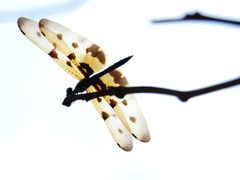
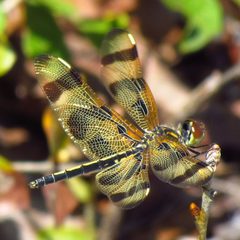
Celithemis fasciata, commonly known as the banded pennant, is a in the skimmer Libellulidae native to the eastern and central United States. are approximately 33 mm in length and are distinguished by extensive, sharply defined black markings on the wings, though wing pattern intensity varies geographically with northern individuals showing less coloration. The species inhabits lentic waters including ponds, lakes, and ditches. Research has demonstrated that individuals exhibit prey preference for small dipteran prey over larger alternatives and engage in prey switching based on relative prey densities.
Pronunciation
How to pronounce Celithemis fasciata: //ˌsɛl.ɪˈθiː.mɪs ˌfæ.siˈeɪ.tə//
These audio files are automatically generated. While they are not always 100% accurate, they are a good starting point.
Identification
The extensive black wing markings are distinctive within the Celithemis. However, the considerable individual and geographic variation in pattern intensity requires caution—northern specimens may appear relatively pale. The combination of wing pattern with the ' typical (ponds, lakes, ditches) and geographic range (south-central, southeastern, and eastern United States) aids identification. Similar congeneric species may overlap in range but differ in wing pattern details.
Images
Habitat
Lentic freshwater including ponds, lakes, and ditches. Specific water quality parameters or vegetation requirements not documented in available sources.
Distribution
Native to the United States. Documented from south-central, southeastern, and eastern regions. Specific state records include Vermont. No records from outside North America in available sources.
Seasonality
activity period not explicitly documented in available sources, though as a temperate-zone likely active during warmer months.
Diet
Predatory on flying insects. Experimental studies demonstrate significant preference for small dipteran prey (Drosophila) over large dipteran prey (Musca domestica) when offered simultaneously. Prey switching occurs when relative prey densities change, with individuals shifting to more abundant prey types. Preference is not absolute; individuals continue to consume some less-preferred larger prey even when alternatives are equally available.
Behavior
Exhibits prey switching in response to changing relative prey densities. Foraging decisions are flexible rather than rigid, with partial preferences maintained even for less-preferred prey types.
Ecological Role
Aerial in freshwater . Specific ecosystem functions beyond general not documented in available sources.
Similar Taxa
- Other Celithemis speciesOverlap in geographic range and preference; distinguished primarily by wing pattern details and extent of black markings
More Details
Prey preference research
Experimental studies using laboratory conditions have quantified foraging , demonstrating that prey preference and switching behavior in this can be measured and manipulated through controlled prey availability.
Sources and further reading
- BugGuide
- Wikipedia
- GBIF taxonomy match
- iNaturalist taxon
- Catalogue of Life
- Buprestidae | Beetles In The Bush | Page 6
- Meet the Crevice Weaver: A Newly Discovered Urban Spider from Colombia | Blog
- Year of the Horse 2026: A selection of equine-related species to celebrate the Lunar New Year | Blog
- Bug Eric: Spider Sunday: Banded Argiope
- Tests of Preference and Switching Behavior of the Dragonfly Celithemis fasciata