
Celithemis eponina
(Drury, 1773)
Halloween Pennant
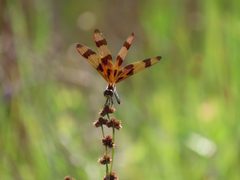
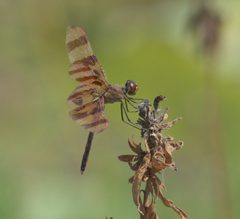
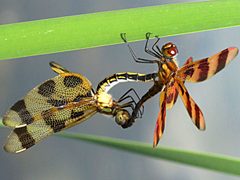
Celithemis eponina, commonly known as the Halloween Pennant, is a medium-sized in the skimmer Libellulidae. It is named for its distinctive orange and black wing coloration that resembles Halloween decorations. The is native to eastern North America and has been documented from Ontario, Canada south to Florida and west to Colorado. It frequents open, sunny near water and is often observed perching prominently on vegetation.
Pronunciation
How to pronounce Celithemis eponina: /ˌsɛlɪˈθɛmɪs ˌɛpəˈnaɪnə/
These audio files are automatically generated. While they are not always 100% accurate, they are a good starting point.
Identification
Distinguished from other Celithemis by the extensive orange and black wing patterning rather than spot-based markings. Celithemis elisa (Calico Pennant) has checkered wing spots without the broad orange bands. Celithemis fasciata (Banded Pennant) has dark wings with pale spots, lacking orange coloration. Perches with wings held forward and slightly downward, a posture unique among North American pennants.
Images
Appearance
Medium-sized with a slender . Wings are long and narrow, marked with bold orange and black bands. The forewings display a black base and orange tips; hindwings show more extensive orange patterning. Body is dark with pale markings. are large and brown. Total body length approximately 38-42 mm, wingspan 60-70 mm.
Habitat
Open, sunny wetlands including marshes, ponds, lakeshores, and slow-moving streams. Prefers areas with emergent vegetation for perching. Often found in disturbed or human-modified wetlands. Tolerates brackish water conditions in coastal areas.
Distribution
Eastern North America from Ontario and Quebec, Canada south to Florida, and west to Colorado and Texas. Disjunct reported in the Caribbean and Middle America. Absent from most of the Great Plains and western North America.
Seasonality
Active from late May through September in northern portions of range; year-round in Florida and the Deep South. Peak abundance in July and August in most regions.
Diet
Aerial capturing small flying insects including mosquitoes, , and small flies. Has been observed hunting from elevated perches.
Life Cycle
laid in water or on aquatic vegetation. Aquatic nymph stage lasts approximately one year. occurs in late spring. live 2-4 weeks.
Behavior
Frequently perches on tall emergent vegetation, often at the very tip of stems. Holds wings angled forward and slightly downward when perched, unlike most that hold wings horizontally or vertically. Males defend territories from elevated perches. Strong, direct with relatively slow wingbeats compared to smaller .
Ecological Role
of small flying insects in wetland . Nymphs serve as prey for fish and other aquatic predators. provide food for birds and other .
Human Relevance
Popular subject for photography and observation due to distinctive coloration and accessible perching . Sometimes used as for wetland health assessment. No significant pest or beneficial economic status.
Similar Taxa
- Celithemis elisaCalico Pennant has checkered black and white or yellow wing spots rather than broad orange and black bands; also perches with wings held horizontally
- Celithemis fasciataBanded Pennant has dark wings with pale spots and lacks orange coloration entirely
- Libellula auripennisGolden-winged Skimmer has solid orange wings without black banding and a more robust body
More Details
Thermoregulation
The orange wing coloration has been suggested to aid in by absorbing solar radiation, though this hypothesis remains untested.
Taxonomic history
Originally described by Dru Drury in 1773 as Libellula eponina, later transferred to Celithemis.