
Grylloblatta campodeiformis
Walker, 1914
Northern Rock Crawler
Grylloblatta campodeiformis, the northern rock crawler, is a wingless, cold-adapted insect to western North America. It was the first grylloblatid described scientifically (Walker, 1914) and serves as the type species for both its and . The species occupies a broader range of than previously assumed, from high-altitude glacial margins to subalpine forests and even low-elevation dry zones. Four are currently recognized, distributed across the Canadian Rockies and adjacent mountain ranges in British Columbia, Alberta, Montana, and Washington.
Pronunciation
How to pronounce Grylloblatta campodeiformis: /ɡrɪloʊˈblætə kæmpoʊˌdiːɪˈfɔːrmɪs/
These audio files are automatically generated. While they are not always 100% accurate, they are a good starting point.
Identification
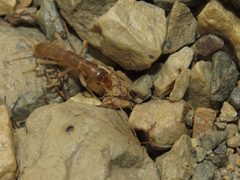
Distinguished from other grylloblatids by with ~70 (some are eyeless or have reduced ). The elongate, wingless body with long legs and uniform honey-yellow coloration separates it from other North American insect orders. identification requires examination of geographic provenance and subtle morphological differences; G. c. campodeiformis is restricted to British Columbia, while G. c. athapaska occurs in British Columbia, Alberta, and Montana, G. c. nahanni in British Columbia, and G. c. occidentalis in Washington state.
Images
Habitat
Occupies diverse cold- including: (1) high-altitude rocky terrain between stones and debris near glacial margins and snowfields (original discovery site at 2,000 m on Sulphur Mountain, Alberta); (2) saproxylic habitats in subalpine forests, specifically within mountain pine beetle-killed trees; (3) atypical low-elevation sites such as the dry belt of British Columbia at 450 m. Can survive temperatures up to 20.5°C but is psychrophilic, becoming active at ~0°C.
Distribution
to western North America. Documented from Alberta (Canadian Rockies, including type locality), British Columbia (Coast Mountains and interior), Montana, and Washington state. Four show geographic partitioning: G. c. campodeiformis (British Columbia), G. c. athapaska (British Columbia, Alberta, Montana), G. c. nahanni (British Columbia), G. c. occidentalis (Washington).
Seasonality
Active year-round in suitable microclimates; activity peaks during cooler periods. Summer collections documented from subalpine forest .
Diet
Obligate . Gut contents in autumn consist almost entirely of arthropods, with tipulid flies . Laboratory studies confirm consume only live or recently killed animal prey; larvae cannot grow without animal food. Also observed foraging for wind-deposited insect fallout on snowfields.
Host Associations
- Tipulidae (tipulid flies) - -prey prey item in autumn gut contents, equally characteristic of cold montane
- Dendroctonus ponderosae (mountain pine beetle) - facilitator uses -killed trees as saproxylic , feeding on subcortical
Life Cycle
Development includes larval stages that require animal food for growth—neither larvae nor survive or develop without animal prey. Number of instars and detailed developmental timeline not documented in available sources. Adults possess variable antennal subsegment counts (24–27).
Behavior
and scavenger that actively searches for small prey. Prey detection mediated by , followed by seizure with . Five types of on antennae and palpi likely involved in prey identification. Ventures onto snowfields to exploit wind-deposited insect fallout. Ground-dwelling, sheltering between stones and debris during daylight hours.
Ecological Role
in cold montane and subalpine . Functions as a saproxylic consumer in -killed forest stands, contributing to nutrient cycling through on subcortical .
Human Relevance
Conservation concern due to specialized requirements and limited ability. Habitat vulnerability includes climate change impacts on cold-adapted refugia and forest management practices affecting saproxylic habitats. Serves as an for intact cold-adapted .
Similar Taxa
- Grylloblatta other species may differ in presence/ number, body proportions, or geographic range; G. campodeiformis distinguished by ~70 eye facets and specific antennal segment ranges
- Other Notoptera (Mantophasmatodea)mantophasmids are African, typically possess , and have different body proportions; no range overlap
- Apterous Orthoptera (e.g., certain katydids, camel crickets)differ in shape, structure, and preferences; grylloblatids have distinctive elongate and leg proportions
Misconceptions
Formerly believed restricted to strictly alpine and glacial margins; subsequent research demonstrated occupancy of subalpine forests and even low-elevation dry habitats. Early reports of omnivory (Wikipedia) contradict primary literature establishing obligate carnivory.
More Details
Taxonomic history
Originally described in order Orthoptera; subsequently transferred to Notoptera (or Grylloblattodea in some classifications). Type for Grylloblattidae and Grylloblatta.
Sensory biology
Five distinct types described from and palpi, all probably involved in prey identification and location.
Subspecies
Four recognized with non-overlapping geographic ranges in western North America, described between 1914 and 1979.
Sources and further reading
- BugGuide
- Wikipedia
- GBIF taxonomy match
- iNaturalist taxon
- NCBI Taxonomy
- Catalogue of Life
- GRYLLOBLATTA CAMPODEIFORMIS WALKER—A NEW RECORD
- OBSERVATIONS ON THE FOOD, FEEDING BEHAVIOUR, AND ASSOCIATED SENSE ORGANS OF GRYLLOBLATTA CAMPODEIFORMIS (GRYLLOBLATTODEA)
- Grylloblatta campodeiformis(Grylloblattodea: Grylloblattidae) uses saproxylic habitats in subalpine forests of western Alberta, Canada: implications for conservation
- TAXONOMY, DISTRIBUTION, AND ZOOGEOGRAPHIC EVOLUTION OFGRYLLOBLATTAIN CANADA (INSECTA: NOTOPTERA)