
Grylloblatta
Walker, 1914
ice crawler, rock crawler
Species Guides
4- Grylloblatta bifratrilecta(rock crawler)
- Grylloblatta campodeiformis(Northern Rock Crawler)
- Grylloblatta chintimini(Marys Peak Ice Cricket)
- Grylloblatta chirurgica(Mount Saint Helens Grylloblattid)
Grylloblatta is a of ice- comprising 15 described to western North America. These insects represent an ancient lineage with obligate physiological dependence on stable near-freezing temperatures, with acute thermal between approximately -8.5°C and 10°C. The genus exhibits deep genetic subdivision and geographic structure, with diversification patterns tied to Pliocene-Pleistocene glacial cycles. Species occur in montane , ice caves, glaciers, and subalpine forests, with some utilizing saproxylic habitats in -killed trees.
Pronunciation
How to pronounce Grylloblatta: /ɡrɪloʊˈblætə/
These audio files are automatically generated. While they are not always 100% accurate, they are a good starting point.
Identification
Distinguished from all other North American insects by combination of: wingless condition, long multi-segmented , reduced , and obligate association with cold microhabitats. Within the , identification relies primarily on male genitalia ; molecular markers ( oxidase subunit II) aid identification of juveniles and females. Distinguished from the related genus Grylloblattella by genitalic and geographic criteria.
Images
Appearance
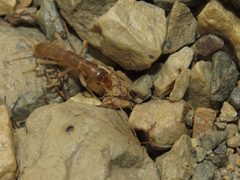
Elongate, wingless insects with a somewhat flattened body. typically 15-30 mm in length. Coloration generally pale to dark brown. long and multi-segmented. long and filamentous with 8-9 segments. reduced or absent; ocelli absent. Legs long and slender, adapted for crawling on ice and rock surfaces. well-developed for . Male genitalia provide primary diagnostic characters for identification.
Habitat
Montane areas, ice caves, glaciers, snowfields, and subalpine forests. Occupies stable near-freezing microhabitats including rock crevices near permanent ice, deep canyon retreats, and saproxylic in -killed subalpine trees. Some occur at relatively low elevations (1500 ft) in dry conditions, expanding habitat beyond strictly alpine environments.
Distribution
to western North America. Occurs in the Rocky Mountain Cordillera, Coast-Cascade Cordillera, Sierra Nevada, Klamath Mountains, and associated ranges. Documented from British Columbia, Alberta, Washington, Oregon, and California. Distribution reflects Pleistocene glacial refugia and subsequent post-glacial range shifts.
Seasonality
Activity patterns constrained by thermal requirements; foraging occurs on snowfields and in sub-freezing microhabitats. Collections documented during summer months from subalpine forest .
Diet
and scavenging. Feeds on live or recently killed prey including wind-blown insects deposited on snowfields and subcortical in dead wood. Gut contents dominated by tipulid flies and other cold-adapted arthropods. Requires animal food for growth; neither nor larvae develop without animal prey.
Life Cycle
Lifespan of 6-10 years. Developmental stages include and nymphal instars preceding adulthood. Extended likely reflects cold-adapted metabolism and environmental constraints of cryophilic .
Behavior
Forages on snowfields where wind-blown insects and organic detritus accumulate. Prey detected primarily by using five described types, then seized by . Exhibits extremely low vagility and poor capacity, restricting to stable microhabitats. or activity patterns in surface .
Ecological Role
Scavenger and in alpine snow-field (Aeolian ecosystem) and subalpine saproxylic . Contributes to nutrient cycling in cold-adapted .
Human Relevance
Subject of conservation concern due to specificity and climate change vulnerability. Serves as for cold-adapted and glacial habitats. Taxonomic interest as representative of ancient insect lineage.
Similar Taxa
- GrylloblattellaRelated in Grylloblattidae distinguished by genitalic and primarily Asian distribution
Misconceptions
Long assumed restricted to strictly alpine and glacial margins; however, documented occurrence in dry low-elevation sites and saproxylic habitats demonstrates broader ecological than previously recognized.
More Details
Conservation Status
Vulnerable to climate warming due to obligate cryophily and low capacity. may serve as indicators of climate change impacts on alpine .
Evolutionary History
Deep genetic divergence among reflects climate-driven diversification during Pleistocene glacial cycles, with distinct glacial refugia in major drainage basins.
Sources and further reading
- BugGuide
- Wikipedia
- GBIF taxonomy match
- iNaturalist taxon
- NCBI Taxonomy
- Catalogue of Life
- GRYLLOBLATTA CAMPODEIFORMIS WALKER—A NEW RECORD
- Evolutionary diversification of cryophilic Grylloblatta species (Grylloblattodea: Grylloblattidae) in alpine habitats of California
- TAXONOMY, DISTRIBUTION, AND ZOOGEOGRAPHIC EVOLUTION OFGRYLLOBLATTAIN CANADA (INSECTA: NOTOPTERA)
- Three new species of Grylloblatta Walker (Insecta: Grylloblattodea: Grylloblattidae), from southern Oregon and northern California
- Two new species of Grylloblatta Walker, 1914 (Grylloblattodea: Grylloblattidae) from western North America, and a neotype designation for G. rothi Gurney 1953
- OBSERVATIONS ON THE FOOD, FEEDING BEHAVIOUR, AND ASSOCIATED SENSE ORGANS OF GRYLLOBLATTA CAMPODEIFORMIS (GRYLLOBLATTODEA)
- Grylloblatta campodeiformis(Grylloblattodea: Grylloblattidae) uses saproxylic habitats in subalpine forests of western Alberta, Canada: implications for conservation
- Descriptions of Two New Species of Grylloblattidae and of the Adult of Grylloblatta barberi, with an Interpretation of Their Geographical Distribution1