
Panorpa
Linnaeus, 1758
scorpionflies, common scorpionflies
Species Guides
41- Panorpa acuta(Sharp Scorpionfly)
- Panorpa americana(common scorpionfly)
- Panorpa anomala(common scorpionfly)
- Panorpa banksi(Banks's Scorpionfly)
- Panorpa banksiana(common scorpionfly)
- Panorpa carolinensis(Carolina scorpionfly)
- Panorpa choctaw(common scorpionfly)
- Panorpa claripennis(common scorpionfly)
- Panorpa confusa
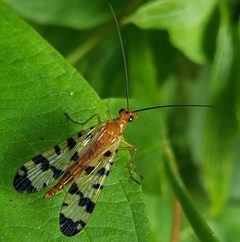
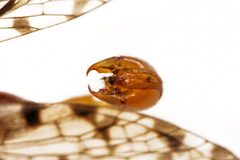
Panorpa is the largest and most widespread of scorpionflies ( Panorpidae), comprising approximately 260 described as of 2018. These insects are characterized by the male's enlarged, -like genital claspers that curl upward at the tip. The genus is primarily distributed in the Northern Hemisphere, with notable absence from western North America. Both larvae and are scavengers that feed on dead or dying arthropods, playing important roles in nutrient cycling and . Several species, particularly P. vulgaris and P. nuptialis, have become model organisms for studying and .
Pronunciation
How to pronounce Panorpa: /pəˈnɔrpə/
These audio files are automatically generated. While they are not always 100% accurate, they are a good starting point.
Identification
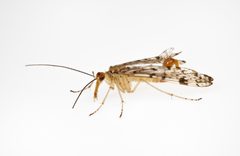
The combination of an elongated rostrum with terminal , two pairs of similarly sized membranous wings with spotted or banded patterns, and (in males) the distinctive upward-curved genital claspers separates Panorpa from all other insect . The superficially similar hangingflies ( Bittacidae, order Mecoptera) have hind legs adapted for catching prey in . Scorpionflies may be confused with caddisflies (Trichoptera) or some neuropterans, but these lack the elongated rostrum and male claspers. -level identification requires examination of male genitalia and wing pattern details.
Images
Habitat
Primarily inhabit the herb stratum of moist, deciduous woodlands and forests. frequent shaded areas with dense understory vegetation, often near streams or in bottomland forests. Larvae occur in soil and leaf litter. Some show affinity for specific microhabitats within forests, with aggressive species tending to dominate lower strata and less aggressive species feeding higher in the vegetation.
Distribution
Widely dispersed in the Northern Hemisphere, including North America, Europe, and Asia. Notably absent from western North America. Thirteen occur in eastern Canada. Highest diversity in eastern North America and eastern Asia (particularly China, with many species).
Seasonality
are primarily active in spring and summer, with -specific periods. In Michigan, adult seasonal periods vary by at sites—species at low-richness sites show extended seasonal distributions compared to those at high-richness sites. Panorpa nuptialis adults emerge February–March in Texas with a lifespan of 3–5 weeks.
Diet
Larvae and are scavengers feeding on dead or dying soft-bodied arthropods; carrion comprises 88.5–100% of diets across . Adults also consume nectar and honeydew. Larvae are known to exhibit .
Life Cycle
Complete . laid singly or in groups of 2–6 in soil. Larvae pass through four instars, developing in soil and leaf litter, feeding on dead arthropods. Larvae construct earthen for in late winter. emerge in spring; lifespan 3–5 weeks. Some overwinter as larvae.
Behavior
are foragers. Males exhibit , offering salivary secretions to females during courtship—this has been extensively studied in P. vulgaris as a model for . are aggressively competitive around food resources; larger species dominate smaller ones at carrion. When approached, adults characteristically flit nervously through dense foliage. Some species have been observed scavenging in spider webs, where they are tolerated or chased by the spider.
Ecological Role
Scavengers and decomposers that contribute to nutrient cycling through consumption of dead arthropods. Serve as prey for various including spiders, birds, and other insects. Some are early colonizers of carrion, with forensic importance—P. nuptialis has been documented as the first insect to arrive at fresh cadavers in some cases, preceding blow flies. Competitive interactions among sympatric species influence structure and individual longevity.
Human Relevance
Used as model organisms in behavioral , particularly for studying , evolution, and sperm competition (P. vulgaris). applications: P. nuptialis and related provide evidence for postmortem interval estimation and decomposition ecology. No significant agricultural or medical importance.
Similar Taxa
- Bittacus (hangingflies)Also in order Mecoptera, but distinguished by hind legs held in a 'hanging' posture; lack the male -like claspers and elongated rostrum of Panorpa.
- Neuroptera (lacewings, antlions)Superficially similar wing venation and body form, but have shorter without elongated rostrum, and different wing coupling mechanisms.
- Trichoptera (caddisflies)Similar size and wing posture, but have hairy wings (vs. membranous with spots in Panorpa), reduced mouthparts, and aquatic larvae.
Misconceptions
More Details
Forensic significance
Panorpa nuptialis has been documented in case studies as an early-arriving at human cadavers, sometimes preceding blow flies. This challenges traditional assumptions about insect on carrion and expands the toolkit available to forensic entomologists.
Sexual selection research
P. vulgaris has become a model insect for testing theories of . Both sexes display mating preferences for direct benefits () and indirect benefits (genetic quality indicators). Male salivary secretions and female nutritional condition signal 'good foraging genes,' with offspring benefits.
Species diversity
The is taxonomically complex and considered , requiring further revision. The P. guttata group alone contains 23 closely related , with 14 described as new from China in 2021. Cryptic species exist, such as P. cryptica from the southeastern United States, initially distinguished by COI mitochondrial .
Sources and further reading
- BugGuide
- Wikipedia
- iNaturalist taxon
- NCBI Taxonomy
- Catalogue of Life
- Panorpidae | Beetles In The Bush
- Forensic Entomology is More than Just Blow Flies and Beetles
- May | 2012 | Beetles In The Bush | Page 2
- One-shot Wednesday | Beetles In The Bush
- Bug Eric: January 2012
- Archives | Beetles In The Bush
- Competition and Coexistence among Panorpa Scorpionflies (Mecoptera: Panorpidae)
- The Life History of Panorpa nuptialis (Mecoptera: Panorpidae)1
- A nearly cryptic Scorpionfly, Panorpa cryptica n. sp. (Mecoptera: Panorpidae) from North America
- Functional Wing Morphology and Aerodynamics of Panorpa Germanica (Insecta: Mecoptera)
- Taxonomy of the Panorpa guttata group (Mecoptera: Panorpidae), with descriptions of fourteen new species from China