
Bittacus
Latreille, 1805
hangingfly, hanging fly
Species Guides
7- Bittacus chlorostigma(hangingfly)
- Bittacus occidentis(Western Hangingfly)
- Bittacus pilicornis(hairy-horned scorpionfly)
- Bittacus punctiger(Brown Spotted Hanging-fly)
- Bittacus stigmaterus(Say's Hanging-fly)
- Bittacus strigosus(striped scorpionfly)
- Bittacus texanus(Texas hangingfly)
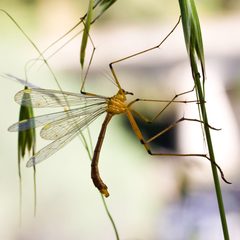
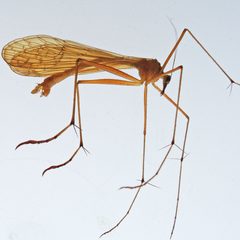
Bittacus is a of hangingflies (Mecoptera: Bittacidae) characterized by their distinctive habit of hanging from vegetation using their modified forelegs. The genus has a distribution and has existed since at least the Late Cretaceous. Bittacus is currently considered grossly , serving as a catch-all for many distantly related . Members are predatory insects with specialized mid- and hindlegs used for capturing prey.
Pronunciation
How to pronounce Bittacus: /ˈbɪtəkəs/
These audio files are automatically generated. While they are not always 100% accurate, they are a good starting point.
Identification
Distinguished from other Mecoptera by the combination of hanging using modified forelegs and mid- and hindlegs. Separated from crane flies (Tipulidae) by presence of two full pairs of wings (crane flies have one pair plus ), raptorial leg modifications, and chewing mouthparts. Distinguished from other Bittacidae by specific wing venation patterns and genitalic characters requiring microscopic examination; the genus is currently and awaits taxonomic revision.
Images
Appearance
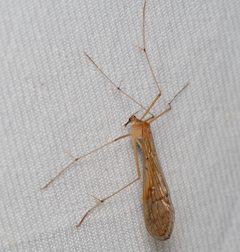
Elongate-bodied insects with extremely long, slender legs. Forelegs modified for grasping vegetation, lacking tarsal claws, used exclusively for hanging. Mid- and hindlegs bear tarsal claws and are , adapted for seizing prey. Two pairs of membranous wings of approximately equal size, with dark mottled patterning. Mouthparts modified for chewing. Overall body form superficially resembles crane flies (Tipulidae) but distinguished by leg and wing venation.
Habitat
Vegetation in forested and semi-forested environments where individuals can hang from leaves and stems. Specific microhabitat preferences vary by ; Brazilian species occur in Amazonian rainforest and Atlantic forest formations.
Distribution
distribution spanning North America, South America, Europe, Asia, Africa, and Australia. Documented from Brazil (18 ), Bolivia, Colombia, Mozambique, Japan, and other regions. Fossil species known from Burmese amber (Cenomanian, Late Cretaceous) and Baltic amber (Eocene).
Diet
prey captured using legs. Males of at least some capture prey items to present as to females.
Life Cycle
Complete with , larva, pupa, and stages. Larvae of Bittacus choui have been described and are campodeiform (elongate, active, with distinct thoracic legs).
Behavior
hang from vegetation using modified forelegs, leaving remaining legs free for prey capture. Males engage in feeding: capturing prey and presenting it to females prior to copulation. Females assess prey quality and may reject small prey items; larger prey increases female receptivity and copulation duration. Males discriminate among females based on size, preferring larger females. This demonstrates mutual mate choice and through both intrasexual competition and intersexual selection.
Ecological Role
of small arthropods. feeding may influence nutrient transfer to females and potentially affect production.
Human Relevance
Subject of behavioral ecological research, particularly regarding and feeding. No documented economic importance or pest status.
Similar Taxa
- HylobittacusAnother Bittacidae ; distinguished by wing venation and genitalic characters, though Bittacus is with respect to it
- Tipulidae (crane flies)Superficially similar elongated body and long legs, but crane flies have only one pair of functional wings (plus ), lack leg modifications, and have siphonate rather than chewing mouthparts
More Details
Taxonomic Status
Bittacus is widely acknowledged to be grossly , serving as a catch-all for many distantly related . A comprehensive taxonomic revision is needed to establish monophyletic genera.
Fossil Record
The has existed since at least the earliest Late Cretaceous, with extinct known from Burmese amber (Cenomanian: Bittacus lepiduscretaceus) and Baltic amber (Eocene: Bittacus succinus).
Cytogenetics
Bittacus cirratus has been studied for its dynamic meiotic of , providing evolutionary insights into dynamics.
Sources and further reading
- BugGuide
- Wikipedia
- GBIF taxonomy match
- iNaturalist taxon
- NCBI Taxonomy
- Catalogue of Life
- The Biology of Bittacus Stigmaterus Say (Mecoptera, Bittacusidæ).*
- The distribution and biology of Bittacus tjederi Londt, 1970 (Mecoptera: Bittacidae)
- Sexual Selection and Nuptial Feeding Behavior in Bittacus apicalis (Insecta: Mecoptera)
- On the Copulatory Behaviour of the Hanging Fly Bittacus italicus (Mecoptera: Bittacidae)
- One new species of hangingfly from Bolivia,Bittacus vazdemelloisp. nov. (Mecoptera: Bittacidae), with an identification key to South American species ofBittacusLatreille
- Supplementary material 1 from: He L-L, Miao Y, Wang H-H, Zhang J, Hua B-Z (2025) Dynamic meiotic behavior and evolutionary insights of supernumerary B chromosomes in the hangingfly Bittacus cirratus (Mecoptera, Bittacidae). Comparative Cytogenetics 19: 91-107. https://doi.org/10.3897/compcytogen.19.153340
- Sexually Selected Predatory and Mating Behavior of the Hangingfly, Bittacus stigmaterus (Mecoptera: Bittacidae)
- Hunting and Mating Behavior in the Japanese Hangingfly Bittacus mastrillii (Mecoptera: Bittacidae)
- Notes on the Bittacus (Mecoptera, Bittacidae) of Mozambique, with the description of a new species
- Cytogenetic comparison between Terrobittacus implicatus and Bittacus planus (Mecoptera: Bittacidae) with some phylogenetic implications
- Variation in Hunting and Mating Behavior in Two Populations of the Japanese Hangingfly Bittacus mastrillii (Mecoptera: Bittacidae)
- Morphology of immature stages ofBittacus choui(Mecoptera: Bittacidae) with notes on its biology
- A new species of Bittacus Latreille (Mecoptera: Bittacidae) from the Andean-Amazonian foothills, Caquetá, Colombia
- The genus Bittacus Latreille (Insecta: Mecoptera) in Brazil: key to species, distribution maps, new synonym, and three new species
- Dynamic meiotic behavior and evolutionary insights of supernumerary B chromosomes in the hangingfly Bittacuscirratus (Mecoptera, Bittacidae).