
Panorpa nuptialis
Gerstaecker, 1863
Nuptial Scorpionfly, common scorpionfly
Panorpa nuptialis is a of in the Panorpidae, found in North America and particularly common in Texas. are known to reach approximately 25 mm (one inch) in length. The species has been documented as an early-arriving insect on human cadavers in studies, where it feeds on bodily fluids. Males possess enlarged, curved claspers at the tip of the that resemble a 's stinger but are used for mating rather than defense.
Pronunciation
How to pronounce Panorpa nuptialis: //pəˈnɔːrpə nʌpˈtiːælɪs//
These audio files are automatically generated. While they are not always 100% accurate, they are a good starting point.
Identification
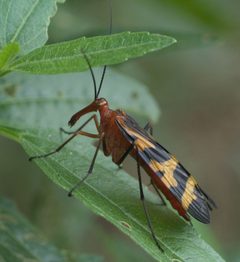
Distinguished from similar Panorpa by the orange wing ground color with defined angulate black bands. The combination of wing pattern and geographic location (particularly Texas) aids identification. Examination of male genitalia may be required for definitive species-level identification within the .
Images
Appearance
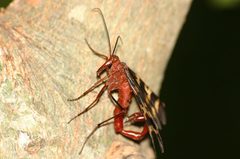
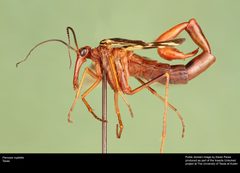
grow up to approximately 25 mm (one inch) in length. Wings are orange with defined, angulate black bands. Males have enlarged, curved claspers at the tip of the , giving a -like appearance. The is elongated with chewing at the terminus.
Habitat
Wooded areas and densely vegetated ravines. Found in moist forest environments with dense understory vegetation.
Distribution
North America; documented as common in Texas. Distribution extends through wooded regions of the central and southern United States.
Diet
feed on fluids from dead or dying soft-bodied insects and other organic matter. Documented feeding on bodily fluids from human cadavers, including fluids seeping from autopsy incisions. Has been observed scavenging prey in spider webs.
Life Cycle
Complete with four larval instars. Larvae live in soil and leaf litter on the forest floor, scavenging on dead or dying soft-bodied insects. occurs in an earthen chamber in the soil.
Behavior
are known to flit nervously through dense foliage when approached. Males use their enlarged abdominal claspers to mate with females; despite the -like appearance, these structures are not used for stinging. Adults have been observed as early arrivals to freshly placed cadavers, where they feed and mate. Documented scavenging in spider webs, stealing prey from sheetweb-weavers.
Ecological Role
Scavenger that contributes to decomposition of soft-bodied organic matter. Documented role in as an early colonizer of human remains. May function as a minor or kleptoparasite in spider webs.
Human Relevance
Documented in studies as one of the first insects to arrive at and feed upon freshly placed human cadavers. This may assist forensic investigators in estimating postmortem intervals. The is harmless to humans despite its suggesting a stinging capability.
Similar Taxa
- Panorpa helenaSimilar wing banding pattern and preference; distinguished by specific wing coloration details and male genitalia structure requiring expert examination.
- Other Panorpa speciesMany share the body plan and wing-banded appearance; precise identification often requires examination of male genitalia.
Misconceptions
Despite the ',' the does not possess a stinger and cannot sting. The curved abdominal tip in males is used for mating, not defense.
More Details
Forensic significance
In a 2012 study, P. nuptialis was the first insect to arrive at a freshly placed clothed cadaver in fall 2009, feeding on fluids from autopsy incisions. This challenges the assumption that blow flies and flesh flies are always the primary early colonizers of human remains.
Sources and further reading
- BugGuide
- Wikipedia
- GBIF taxonomy match
- iNaturalist taxon
- NCBI Taxonomy
- Catalogue of Life
- Forensic Entomology is More than Just Blow Flies and Beetles
- One-Shot Wednesday: Panorpa helena scorpionfly | Beetles In The Bush
- Panorpidae | Beetles In The Bush
- May | 2012 | Beetles In The Bush | Page 2
- One-shot Wednesday | Beetles In The Bush
- Bug Eric: January 2012
- The Life History of Panorpa nuptialis (Mecoptera: Panorpidae)1