
Panorpa helena
Byers, 1962
Helena's Scorpionfly, common scorpionfly
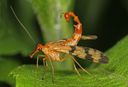
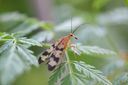
Panorpa helena is a of in the Panorpidae, described by George Byers in 1962. It is one of the most common and widespread scorpionfly species in eastern North America. The species is distinguished by three complete dark bands across its yellow wings and, in males, the presence of an anal horn on the sixth abdominal . are typically encountered in dense, moist forest where they flit nervously through foliage.
Pronunciation
How to pronounce Panorpa helena: //ˈpænɔrpə hɛˈleɪnə//
These audio files are automatically generated. While they are not always 100% accurate, they are a good starting point.
Identification
Distinguished from other Panorpa by three complete dark bands across yellow wings (not broken or incomplete) and presence of anal horn on sixth abdominal in males. In Missouri, where six Panorpa species occur, these features separate it from . Examination of male genitalia provides conclusive identification. The species' early spring (April–May) may aid in field recognition where phenological differences exist among sympatric species.
Images
Appearance
Medium-sized with elongated, horse-like and distinctive wing pattern. Wings are yellow with three complete dark transverse bands. Males possess an anal horn on the sixth abdominal —a key diagnostic feature. Body coloration is generally yellowish to brownish. The terminates in an upturned, -like structure (hence the ), more pronounced in males.
Habitat
Dense, moist deciduous forests, particularly wet bottomland forests along streams and rivers. Associated with rich, shaded understory vegetation where rest on foliage and flit between plants.
Distribution
Eastern North America. Documented from Missouri (type locality region), Vermont, and broadly across the eastern United States. GBIF records confirm presence in North America with specific occurrences in Vermont, USA.
Seasonality
active in spring, with observations from late April through summer. First recorded occurrence at Norm Penny's database: May 4. An April 23 observation in Missouri (2012) represents an unusually early record, nearly two weeks before the documented first date.
Behavior
exhibit nervous, fluttering through dense foliage when approached. Typically difficult to photograph due to quick escape into deeper vegetation. Males and females engage in complex courtship typical of scorpionflies, involving presentation.
Human Relevance
Occasional subject of nature photography and entomological interest due to distinctive appearance. Serves as for intact moist forest . No known economic importance or pest status.
Similar Taxa
- Other Panorpa speciesWing banding patterns differ: P. helena has three complete bands versus broken, incomplete, or differently arranged bands in . Male anal horn presence and structure varies among .
- Panorpa nuptialisSimilar size and but wing pattern and male genitalia differ; requires close examination for separation.
More Details
Taxonomic Authority
described by George W. Byers in 1962, a prominent Mecoptera and former student of George Byers at the University of Kansas. The specific epithet 'helena' honors an individual (likely Helena Leal, though this is speculative given the 1962 description date predates the Leal 's prominence in entomology).
Photographic Challenge
Considered a difficult subject for photography due to nervous and preference for dense foliage. Single-shot opportunities are common; sustained observation or multiple photographs typically require patience or cooperative weather conditions (cool temperatures reduce activity).
Sources and further reading
- BugGuide
- Wikipedia
- GBIF taxonomy match
- iNaturalist taxon
- NCBI Taxonomy
- Catalogue of Life
- Davis Teen: How Those Pesky Mosquitoes Led to a Scientific Publication | Bug Squad
- Congrats to NAI Fellow UC Davis Distinguished Professor Walter Leal | Bug Squad
- One-Shot Wednesday: Panorpa helena scorpionfly | Beetles In The Bush
- May | 2012 | Beetles In The Bush | Page 2
- One-shot Wednesday | Beetles In The Bush
- Archives | Beetles In The Bush