
Merope tuber
Newman, 1838
forcepfly, earwigfly
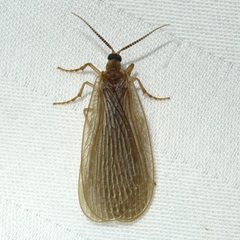
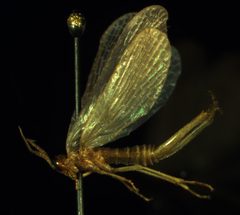
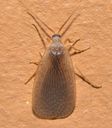
Merope tuber is the sole in the Merope and the only living member of the Meropeidae in North America. The species occurs in eastern North America from Ontario to Georgia and west to Kansas, with recent records from Florida. are and secretive, rarely encountered due to their ground-dwelling habits. The species is notable for the large genital forceps present on male , which resemble the of . stages remain unknown, and much of the species' is poorly understood.
Pronunciation
How to pronounce Merope tuber: /ˈmɛ.ɹoʊ.pi ˈtu.bɛɹ/
These audio files are automatically generated. While they are not always 100% accurate, they are a good starting point.
Identification
Males are immediately recognizable by the large, segmented genital forceps on the that resemble ; the function of these structures is unknown but may be involved in courtship. have long wings with numerous and lack ocelli. The body is dorsoventrally flattened. A distinctive region of interlocking holds the and scutellum together on the middle thoracic segment, possibly functioning to keep wings aligned during movement through soil.
Images
Habitat
have been found under logs, in near streams, and attracted to lights at night. The flat body form and lack of ocelli suggest to ground-level microhabitats such as rock crevices and soil fissures.
Distribution
Eastern North America from Ontario south to Georgia, west to Kansas, with recent records from Florida.
Behavior
Human Relevance
Occasionally encountered by entomologists in and at light traps. The serves as an example of relictual insect diversity in North America.
Similar Taxa
- Austromerope brasiliensisAlso a forcepfly ( Meropeidae) with male genital forceps, but occurs in Brazil (Neotropical region) rather than North America; represents the only other extant in the family.
- Bittacus spp.Hangingflies ( Bittacidae, order Mecoptera) share the order but lack the distinctive male genital forceps and have elongated bodies with hind legs for hanging from vegetation.
Sources and further reading
- BugGuide
- Wikipedia
- GBIF taxonomy match
- iNaturalist taxon
- NCBI Taxonomy
- Catalogue of Life
- Pensoft blog - Part 147
- Spectacular forcepfly species discovered for the first time in South America | Blog
- Uncategorized | Blog - Part 42
- Fulgoridae | Beetles In The Bush
- defensive behavior | Blog
- September | 2021 | Beetles In The Bush