
Meropeidae
earwigflies, forcepflies
Genus Guides
1- Merope(earwigfly)
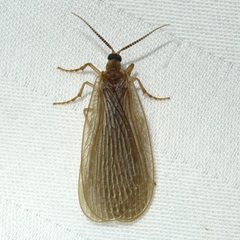
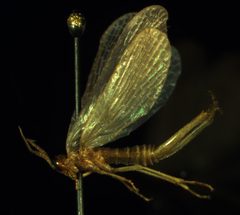
is a of tiny scorpionflies (order Mecoptera) containing only three extant . The family is commonly called '' or 'forcepflies' due to the prominent forceps-shaped male genitalia resembling . The living species exhibit a highly disjunct distribution: Merope tuber in North America, Austromerope poultoni in Western Australia, and A. brasiliensis in South America. The fossil record extends to the Jurassic, with the family considered living fossils and occupying a basal position within Mecoptera. The of extant species remains largely unknown, with larvae never observed.
Pronunciation
How to pronounce Meropeidae: //məˈroʊ.pi.aɪˌdiː//
These audio files are automatically generated. While they are not always 100% accurate, they are a good starting point.
Identification
Males possess large, -like genital forceps that are diagnostic for the . are tiny scorpionflies with reduced wing venation compared to other mecopteran families. The forceps-like male genitalia distinguish from all other Mecoptera families.
Images
Habitat
have been collected in woodland, Jarrah forest, sand plain vegetation, and Atlantic Forest fragments. In the mid-Atlantic United States, specimens have been recorded from freshwater tidal marshes, low forests, and their . Adults appear to be ground-dwelling.
Distribution
Disjunct distribution across three continents: eastern North America (Merope tuber), Western Australia (Austromerope poultoni), and southeastern Brazil (Austromerope brasiliensis). The pattern suggests origin prior to Pangaean breakup.
Behavior
are and ground-dwelling. Males are capable of stridulation, producing sound by rubbing certain body parts together.
Similar Taxa
- EomeropidaeClosest living relatives, also a relictual with single extant and Jurassic fossil record; distinguished by different wing venation and genital structure
- PanorpidaeCommon scorpionflies with elongated rostrum and different male genital structure lacking forceps-like
- BittacidaeHangingflies with elongated body and hind legs for prey capture, not ground-dwelling
More Details
Fossil Record
The has an extensive fossil record extending to the Middle Jurassic (Boreomerope antiqua from Siberia). Extinct include Burmomerope and Torvimerope from mid-Cretaceous Burmese amber. The genus Thaumatomerope was removed to its own family Thaumatomeropidae in 2002.
Taxonomic History
The was originally spelled 'Meropidae' but was changed to '' by ICZN Opinion 140 in 1943 to avoid homonymy with the bird family Meropidae (-eaters).
Evolutionary Significance
The occupies a basal phylogenetic position within Mecoptera. The disjunct modern distribution and ancient fossil record support interpretation as living fossils. Mid-Cretaceous fossils show mandibular not seen in extant , suggesting more complex historical feeding .
Sources and further reading
- BugGuide
- Wikipedia
- GBIF taxonomy match
- iNaturalist taxon
- NCBI Taxonomy
- Catalogue of Life
- Uncategorized | Blog - Part 42
- Pensoft blog - Part 147
- Spectacular forcepfly species discovered for the first time in South America | Blog
- Evolution and mandibular sexual dimorphism in mid‐Cretaceous scorpionflies (Insecta: Mecoptera: Meropeidae)
- Mecopteran (Mecoptera: Bittacidae, Meropeidae, Panorpidae) Flight Periods, Sex Ratios, and Habitat Frequencies in a United States Mid-Atlantic Freshwater Tidal Marsh, Low Forest, and Their Ecotone