
Merope
Newman, 1838
earwigfly, forcepfly
Species Guides
1- Merope tuber(forcepfly)
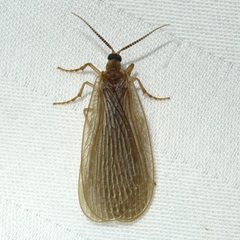
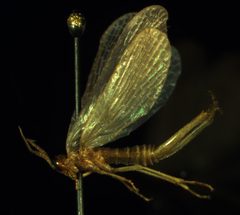
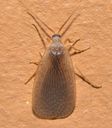
Merope is a of scorpionflies (Mecoptera) in the Meropeidae, commonly known as earwigflies or forcepflies. The genus contains Merope tuber, the only living member of Meropeidae in North America. Males possess large segmented forceps-like that resemble the pincers of . The family is exceptionally rare, with only three extant described worldwide, and the stages remain unknown to science.
Pronunciation
How to pronounce Merope: /ˈmɛrəpiː/
These audio files are automatically generated. While they are not always 100% accurate, they are a good starting point.
Images
Habitat
Merope tuber occurs in woodland, Jarrah forest, and sand plain vegetation. The has been found in forest fragments and areas with ground cover suitable for ground-dwelling .
Distribution
Merope tuber occurs throughout eastern North America from Ontario to Georgia, west to Kansas, and has been recorded in Florida. The Meropeidae has a disjunct distribution, with the related Austromerope found in the Neotropical region (Brazil), suggesting a relict Gondwanan distribution pattern.
Life Cycle
The stages of Merope remain unknown. are and appear to live on the ground.
Behavior
are and ground-dwelling. Males are capable of stridulation, producing sound by rubbing certain body parts. The function of the prominent male forceps is unknown but has been hypothesized to play a role in courtship.
Similar Taxa
- AustromeropeBoth belong to Meropeidae and share the forcepfly with large male genital forceps; Austromerope is found in the Neotropical region (Brazil) while Merope is Nearctic
- BittacusBoth are in order Mecoptera (scorpionflies), but Bittacus ( Bittacidae, hangingflies) has elongated wings held roof-like over the body and hind legs for catching prey, lacking the forcep-like male of Merope
More Details
Phylogenetic significance
The discovery of Austromerope in Brazil represented the first Neotropical record of Meropeidae, supporting the hypothesis that the originated before continental drift and diverged into northern and southern branches with the breakup of Pangea. This makes Meropeidae a classic example of a relict family with a Gondwanan distribution.
Taxonomic rarity
With only three extant described across two (Merope and Austromerope), Meropeidae is one of the smallest and least diverse of insects, despite its wide geographic separation between North and South America.