
Sparganothis violaceana
(Robinson, 1869)
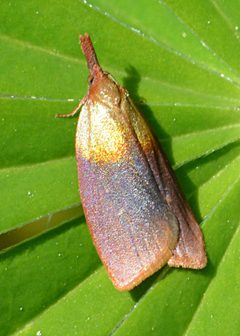
Sparganothis violaceana is a small tortricid native to eastern and central North America. are active in late spring, with a wingspan of 16–21 mm. The is associated with Vaccinium plants, placing it among the complex of insects that interact with blueberry and cranberry . The Sparganothis includes several economically significant fruitworm species, though the specific agricultural impact of S. violaceana remains poorly documented compared to like S. fruitworma.
Pronunciation
How to pronounce Sparganothis violaceana: /ˌspɑːrɡəˈnoʊθɪs viˌɒləˈkeɪnə/
These audio files are automatically generated. While they are not always 100% accurate, they are a good starting point.
Identification
Distinguished from other Sparganothis by combination of small size (16–21 mm wingspan), violet-tinged coloration, and geographic distribution in northeastern North America. Separation from S. fruitworma and S. sulfureana requires examination of genitalia or detailed wing pattern analysis; these are generally larger and show different coloration (yellow-brown or sulfurous tones in S. sulfureana).
Images
Habitat
Associated with Vaccinium-dominated including blueberry barrens, cranberry bogs, and acidic woodland understories. Specific microhabitat preferences for larvae and pupae are not documented.
Distribution
Eastern and central North America: Alberta, Connecticut, Maine, Manitoba, Maryland, Massachusetts, Minnesota, New Brunswick, New Hampshire, New Jersey, Nova Scotia, Ontario, Pennsylvania, Quebec, Saskatchewan, Vermont, and Virginia.
Seasonality
active May to June. Larval and stage not documented.
Diet
Larvae feed on Vaccinium (Ericaceae). Specific Vaccinium and whether feeding occurs on leaves, flowers, or fruit are not documented.
Host Associations
- Vaccinium - larval food plant-level association only; specific unconfirmed
Life Cycle
Complete with , larva, pupa, and stages. Details of egg deposition site, larval instar number, location, and stage are not documented.
Ecological Role
Herbivore in Vaccinium-dominated . and interactions with other blueberry/cranberry herbivores are not studied. Potential role as prey for and is inferred from -level patterns but not documented for this .
Human Relevance
Indirectly relevant to blueberry and cranberry agriculture through shared with major pests. No documented direct economic impact; not mentioned in pest management literature. Potential for misidentification with Sparganothis fruitworma, a significant cranberry pest, may cause confusion in monitoring programs.
Similar Taxa
- Sparganothis fruitwormaLarger size, significant cranberry pest, different coloration (more brownish), overlapping range in northeastern North America
- Sparganothis sulfureanaYellow-sulfur wing coloration, larger size, broader range including non-Vaccinium plants
- Sparganothis xanthoidesYellow-orange coloration, different geographic distribution
More Details
Research context
Mentioned in climate change research on cranberry pests as part of the Sparganothis complex requiring future study, but no specific data on S. violaceana responses to temperature or competition.
Taxonomic note
Original description as Tortrix violaceana by Robinson in 1869; transferred to Sparganothis by subsequent .