
Sparganothis bistriata
Kearfott, 1907
Two-striped Sparganothis Moth
Sparganothis bistriata is a of tortricid found in the southeastern and mid-Atlantic United States. It is a small moth with a wingspan of approximately 22 mm. The species is part of the Sparganothis, which includes several species associated with fruit crops. It is commonly known as the Two-striped Sparganothis Moth.
Pronunciation
How to pronounce Sparganothis bistriata: /spɑrˈɡænəθɪs bɪˈstraɪətə/
These audio files are automatically generated. While they are not always 100% accurate, they are a good starting point.
Identification
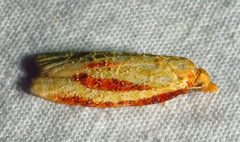
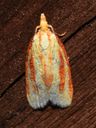
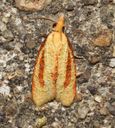
The specific epithet 'bistriata' and 'Two-striped Sparganothis ' suggest two longitudinal stripes on the wings as a distinguishing feature. Differentiation from other Sparganothis would require examination of genitalia or detailed wing pattern analysis. The small size (wingspan ~22 mm) is consistent with the but not diagnostic alone.
Images
Appearance
Small with a wingspan of approximately 22 mm. As a member of Tortricidae, it likely has the characteristic bell-shaped wing posture at rest. The specific meaning of the epithet 'bistriata' (two-striped) suggests two longitudinal stripes on the wings, though detailed pattern description is not available in the sources.
Distribution
United States: Arkansas, Florida, Georgia, Louisiana, Mississippi, North Carolina, Pennsylvania, South Carolina, Texas, and Virginia.
Human Relevance
Members of the Sparganothis include agricultural pests. The related Sparganothis fruitworm (likely S. sulfureana or S. pilleriana) is mentioned as a cranberry pest in New Jersey, though the specific pest status of S. bistriata is not documented in the provided sources.
Similar Taxa
- Sparganothis sulfureanaAlso in Sparganothis and known as a cranberry fruitworm pest; may overlap in range and
- Sparganothis pillerianaRelated Sparganothis associated with fruit crops
More Details
Taxonomic authority
First described by Kearfott in 1907.
Observation records
49 observations recorded on iNaturalist as of the source date.