
Acrobasis vaccinii
Riley, 1884
cranberry fruitworm, Cranberry Fruitworm Moth
is a small pyralid whose larvae are significant pests of cultivated blueberries and cranberries. emerge after bloom and fruit set, with females depositing on unripe berries. Larvae feed internally on berry contents, consuming up to eight fruits to complete development. The has one per year and overwinters as full-grown larvae in cocoons.
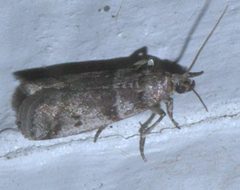
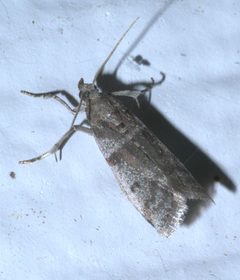
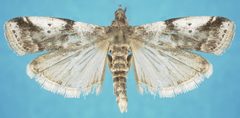
Pronunciation
How to pronounce Acrobasis vaccinii: /ˌækrəˈbeɪsɪs vækˈsɪniˌaɪ/
These audio files are automatically generated. While they are not always 100% accurate, they are a good starting point.
Identification
Larvae can be identified by their green coloration with brownish-red markings and their presence inside damaged berries, where they leave characteristic . are small requiring dissection or genitalia examination for definitive identification from related Acrobasis . are minute, flat, white, and -like, requiring hand lens magnification to detect in calyx cups.
Images
Appearance
have a wingspan of 16–18 mm. Larvae are mostly green with brownish-red pigmentation on the surface, reaching approximately half an inch (12–13 mm) before . are flat, white, -like, and deposited on or within the calyx cup of berries.
Habitat
Found in commercial and wild stands of Vaccinium , including cultivated blueberry and cranberry bogs. Occupies environments where plants flower and fruit, from early season through harvest.
Distribution
Native to eastern North America from Nova Scotia to Florida and west to Wisconsin and Texas. Introduced to Washington State.
Seasonality
emerge after full bloom and fruit set. One per year. Larvae present during fruit development; full-grown larvae overwinter in cocoons.
Diet
Larvae feed internally on developing fruits of Vaccinium corymbosum (highbush blueberry), Vaccinium macrocarpon (cranberry), Vaccinium vitis-idaea (lingonberry), and Vaccinium stamineum (deerberry). Each larva consumes the contents of multiple berries, typically 4–8, to complete development.
Host Associations
- Vaccinium corymbosum - larval highbush blueberry
- Vaccinium macrocarpon - larval cranberry
- Vaccinium vitis-idaea - larval lingonberry
- Vaccinium stamineum - larval deerberry
Life Cycle
One per year. laid on unripe berries. Larvae feed internally on berry contents, moving between fruits. Full-grown larvae exit berries and overwinter in silken cocoons in leaf litter or soil. occurs in spring, with timed to plant bloom and early fruit development.
Behavior
Females oviposit preferentially on or within the calyx cups of unripe berries. Laboratory studies indicate females may prefer larger fruits when available, though field studies show no discrimination between fruit sizes within patches, possibly due to competition for early-season oviposition sites. Larvae feed concealed within berries, tunneling between fruits as they develop.
Ecological Role
Primary fruit pest in cultivated Vaccinium systems. Larval feeding reduces yield and fruit quality. Serves as for including in Mesostenus (Ichneumonidae).
Human Relevance
Major economic pest of blueberry and cranberry production. Management relies on trapping (ISCAlure-Vaccinii) to time applications, manual removal of infested berries, and inspection of calyx ends for . Multiple insecticide classes are labeled for control, with increasing use of selective materials to preserve natural enemies.
Similar Taxa
- Acrobasis nuxvorellaPecan nut casebearer; similar size and but feeds exclusively on pecan (Carya illinoinensis), with distinct forewing markings including a ridge of dark
- Acrobasis stigmellaAnother Vaccinium-feeding Acrobasis ; requires genitalia dissection for definitive separation from A. vaccinii
More Details
Oviposition Behavior
Research indicates that while A. vaccinii females show preference for larger fruits in laboratory settings, this discrimination is not observed in natural bog environments, likely due to intense competition for early-season oviposition sites before fruit maturation is complete.
Monitoring Technology
The synthetic ISCAlure-Vaccinii, developed by ISCA Technologies, is specifically marketed for monitoring this and has been demonstrated as highly effective for timing management interventions.
Sources and further reading
- BugGuide
- Wikipedia
- GBIF taxonomy match
- iNaturalist taxon
- NCBI Taxonomy
- Catalogue of Life
- Pecan Nut Casebearer: New Guide Provides IPM Options
- Bug Eric: Wasp Wednesday: Mesostenus
- Bug Eric: A Potential New Host Record for Calliephialtes grapholithae (Hymenoptera: Ichneumonidae) from a Paper Wasp nest (Hymenoptera: Vespidae: Polistes metricus)
- A Color Variant of Cranberry Fruitworm, Acrobasis vaccinii, and Host Records of Acrobasis amplexella (Lepidoptera: Phycitidae)
- Is fruit size important in the selection of oviposition sites by cranberry fruitworm, Acrobasis vaccinii?