
Platynota idaeusalis
(Walker, 1859)
Tufted Apple Bud Moth
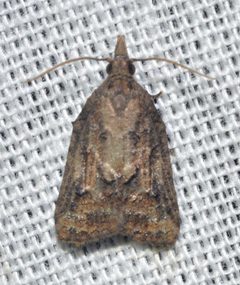
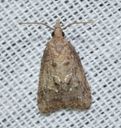
Platynota idaeusalis, the tufted apple bud , is a tortricid moth native to eastern North America. It is a significant agricultural pest, particularly of apples in the mid-Atlantic region of the United States. The has been documented as a for both alphabaculovirus and betabaculovirus isolates, making it a subject of biocontrol research. Larvae are known to feed on diverse host plants and have developed resistance to certain .

Pronunciation
How to pronounce Platynota idaeusalis: //ˌplætɪˈnoʊtə ˌɪdiːəˈsælɪs//
These audio files are automatically generated. While they are not always 100% accurate, they are a good starting point.
Identification
The broad wingspan range (12–25 mm) reflects sexual size dimorphism, with females at the upper end and males at the lower end. As a tortricid , it can be distinguished from similar by genitalia examination or molecular methods; external alone may not reliably separate it from without expert analysis.
Images
Appearance
have a wingspan of 12–25 mm. The exhibits in size, with females typically larger than males. As a member of Tortricidae, adults likely display the characteristic bell-shaped wing posture at rest typical of leafroller moths, though specific coloration and pattern details are not provided in available sources.
Habitat
Eastern North America, with strong association with apple orchards in the mid-Atlantic USA. Found in diverse environments supporting its plant range, from natural vegetation to cultivated agricultural settings.
Distribution
Eastern North America, from Ontario south to Florida and west to Oklahoma. Also recorded in the Pacific Northwest region of North America. Canadian provincial records include Alberta, Manitoba, and Saskatchewan.
Seasonality
are active from June to July in northern portions of the range. Multiple occur per year throughout its distribution.
Diet
Larvae feed on a diverse range of plants. The is a significant direct pest of apples (Malus spp.) in the mid-Atlantic USA. Specific larval host plant records beyond apple are not detailed in available sources.
Host Associations
- apple - pestsignificant direct pest in mid-Atlantic USA orchards
- diverse host plants - larval food plantgeneral statement from literature; specific plants not enumerated
Life Cycle
Multiple per year. Specific details of , larval, and pupal stages are not provided in available sources. Larval stage is the damaging phase, feeding on plant tissues.
Behavior
are and attracted to ultraviolet light sources. Larvae are leaf-feeding and associated with rolling or tying plant tissues, consistent with Tortricidae 'leafroller moths'. Specific behavioral details beyond period and number are not documented in available sources.
Ecological Role
Herbivore and agricultural pest. Serves as for (Platynota idaeusalis and ), which have been investigated for potential. Subject of by solitary including Monobia quadridens, which provisions nests with paralyzed caterpillars of this and related .
Human Relevance
Significant economic pest of apple production in the mid-Atlantic USA. Subject of resistance research; have demonstrated resistance to azinphosmethyl through elevated monooxygenase, esterase, and glutathione transferase activity. Investigated as a target for viral biocontrol agents.
Similar Taxa
- Platynota stultanaAlso in Platynota, known as the omnivorous leafroller moth; both are tortricid pests with overlapping geographic ranges and similar larval habits
- Other TortricidaeMany tortricid moths share similar size ranges, wing shape, and larval leaf-rolling ; definitive identification requires genitalia dissection or molecular analysis
More Details
Viral Research
Two distinct have been isolated from P. idaeusalis: an alphabaculovirus (Platynota idaeusalis isolate 2680, PlidNPV-2680) with a 121,881 , and a betabaculovirus (Platynota idaeusalis isolate 2683, PlidGV-2683) with a 106,633 bp genome. Genome sequencing revealed a 1516 bp region with 97.5% sequence identity between the two viruses, indicating recent between alphabaculovirus and betabaculovirus lineages in this .
Insecticide Resistance
Research has documented biochemical mechanisms of resistance to azinphosmethyl, an , involving elevated activity of detoxification including monooxygenases, esterases, and glutathione transferases.
Sources and further reading
- BugGuide
- Wikipedia
- GBIF taxonomy match
- iNaturalist taxon
- NCBI Taxonomy
- Catalogue of Life
- What Will You See at Bohart Museum Open House | Bug Squad
- Oh, What a (Moth) Night! | Bug Squad
- Like a Moth to a Flame... | Bug Squad
- Bug Eric: Wasp Wednesday: Four-toothed Mason Wasp
- The Genome Sequences of Baculoviruses from the Tufted Apple Bud Moth, Platynota idaeusalis, Reveal Recombination Between an Alphabaculovirus and a Betabaculovirus from the Same Host
- Monooxygenase, Esterase, and Glutathione Transferase Activity Associated with Azinphosmethyl Resistance in the Tufted Apple Bud Moth,Platynota idaeusalis