
Cenopis niveana
Walsingham, 1879
Aproned Cenopis Moth
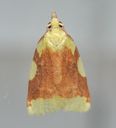
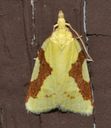
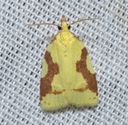
A tortricid of eastern North America, historically classified under Sparganothis. The exhibits the characteristic bell-shaped resting posture of leafroller moths. are active during warmer months, with over 800 observations documented.
Pronunciation
How to pronounce Cenopis niveana: /sɛˈnoʊpɪs nɪˈviːænə/
These audio files are automatically generated. While they are not always 100% accurate, they are a good starting point.
Identification
The pale ground color combined with the darker forewing patch separates this from similar Cenopis and Sparganothis species. Cenopis directana (Chokecherry Leafroller) has more uniform gray-brown coloration without a contrasting apical patch. Cenopis pettitana shows more distinct transverse bands. Genitalia examination may be required for definitive identification of worn specimens.
Images
Appearance
have white to pale cream forewings with variable brownish or grayish markings. A distinctive darker patch or 'apron' on the forewing gives the its . Wingspan approximately 15–20 mm. At rest, wings fold roof-like over the body, creating a bell-shaped silhouette typical of Tortricidae.
Habitat
Deciduous forests, woodland edges, and shrubby areas. Associated with plants in the Rosaceae .
Distribution
Eastern North America: southeastern Canada (Ontario, Quebec, Maritime provinces) and eastern United States, west to approximately the Great Plains and south to the Gulf Coast states.
Seasonality
have been recorded from May through September, with peak activity in June and July. Multiple may occur in southern portions of the range.
Host Associations
- Prunus - larval chokecherry and other Prunus
- Crataegus - larval hawthorns
Life Cycle
Larvae are leafrollers, feeding within folded or rolled leaves of plants. occurs in the larval shelter. stage not definitively established; likely as larva or pupa.
Behavior
are and attracted to light. Larvae construct leaf rolls for shelter and feeding, typical of Tortricidae.
Ecological Role
Larvae function as herbivores on woody shrubs and trees. The contributes to leafroller guild diversity in eastern deciduous forest .
Human Relevance
Minor occasional pest of cultivated Prunus (stone fruits), though rarely economically significant. The is more commonly encountered by enthusiasts and in biodiversity surveys.
Similar Taxa
- Cenopis directanaSimilar size and , but lacks the contrasting forewing patch; more uniformly colored
- Cenopis pettitanaOverlapping range, but shows more distinct banding pattern rather than patch
- Sparganothis sulfureanaFormerly congeneric; has yellowish ground color and different wing pattern
More Details
Taxonomic history
Originally described as Sparganothis niveana by Walsingham in 1879. Transferred to Cenopis based on morphological and molecular phylogenetic studies that split the broadly defined Sparganothis. The Cenopis now contains with distinct genitalic and wing pattern characteristics.
Etymology
Specific epithet niveana derives from Latin 'niveus' meaning snowy or snow-white, referring to the pale ground color of the forewings.