
Cenopis mesospila
Zeller, 1875
White-tailed Fruitworm, White-tailed Fruitworm Moth
A tortricid of eastern North America, historically classified under Sparganothis but now placed in Cenopis. are small moths with distinctive patterning. The references both the adult's appearance and its larval association with fruit.
Pronunciation
How to pronounce Cenopis mesospila: /sɛˈnoʊpɪs ˌmɛsəˈspaɪlə/
These audio files are automatically generated. While they are not always 100% accurate, they are a good starting point.
Identification
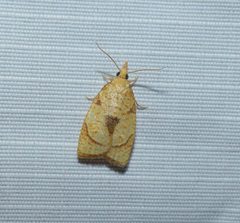
The combination of yellowish-tan forewings with brown markings and conspicuously white hindwings separates this from most similar Cenopis and Sparganothis . Cenopis directana (Chokecherry Leafroller) has more uniformly colored wings without the contrasting white hindwings. Cenopis pettitana shows different forewing pattern elements. Genitalia examination may be required for definitive identification of worn specimens.
Images
Appearance
forewings are yellowish to tan with variable brownish markings; the hindwings are white to pale gray, giving the 'white-tailed' appearance. Wingspan approximately 15-20 mm. The pattern includes a darker band and often a costal spot. Resting posture is typical of Tortricidae, with wings held roof-like over the body.
Habitat
Deciduous forests, woodland edges, and areas with fruit-bearing shrubs and trees. Associated with plants in the Rosaceae .
Distribution
Eastern North America: Connecticut, Illinois, Indiana, Kentucky, Maine, Maryland, Massachusetts, Michigan, New York, Ohio, Ontario, Pennsylvania, Quebec, Tennessee, and West Virginia.
Seasonality
have been recorded from May through August, with peak activity in June and July. Multiple may occur.
Diet
Larvae feed on fruits of Rosaceae, including cherry (Prunus), apple (Malus), and possibly other stone and pome fruits.
Host Associations
- Prunus - larval food plantcherry
- Malus - larval food plantapple
Life Cycle
Complete with , larva, pupa, and stages. Larvae are fruit borers, feeding inside developing fruits. stage not definitively established; likely as larva or pupa.
Behavior
are and attracted to light. Larvae bore into fruits and feed internally, causing damage characteristic of fruitworm moths.
Ecological Role
As a fruit-boring larva, acts as a consumer of Rosaceae fruits. Contributes to natural fruit abortion and may serve as prey for and birds.
Human Relevance
Minor pest of cultivated cherry and apple, though generally less damaging than primary fruit pests. Larval feeding causes fruit drop and internal damage.
Similar Taxa
- Cenopis directanaSimilar size and general appearance, but lacks white hindwings and has more uniform forewing coloration
- Cenopis pettitanaOverlapping range and ; differs in forewing pattern details
- Sparganothis sulfureanaFormerly congeneric; yellow coloration differs from C. mesospila's tan and white pattern
Misconceptions
Long classified in Sparganothis based on superficial resemblance; molecular and morphological data support placement in Cenopis.
More Details
Taxonomic history
Originally described by Zeller in 1875. Transferred from Sparganothis to Cenopis based on revised generic concepts in Tortricidae. The name 'mesospila' refers to the middle spot pattern on the forewing.